
Christmas with R.E. Lee (1867)
(The following two extracts are from R.E. Lee Jr.’s 20th century publication of his father’s letter. They deal with General Lee’s time in Lexington Virginia two years after the Civil War. For a full text, please see: https://archive.org/download/recollectionslet00lee/recollectionslet00lee.pdf)
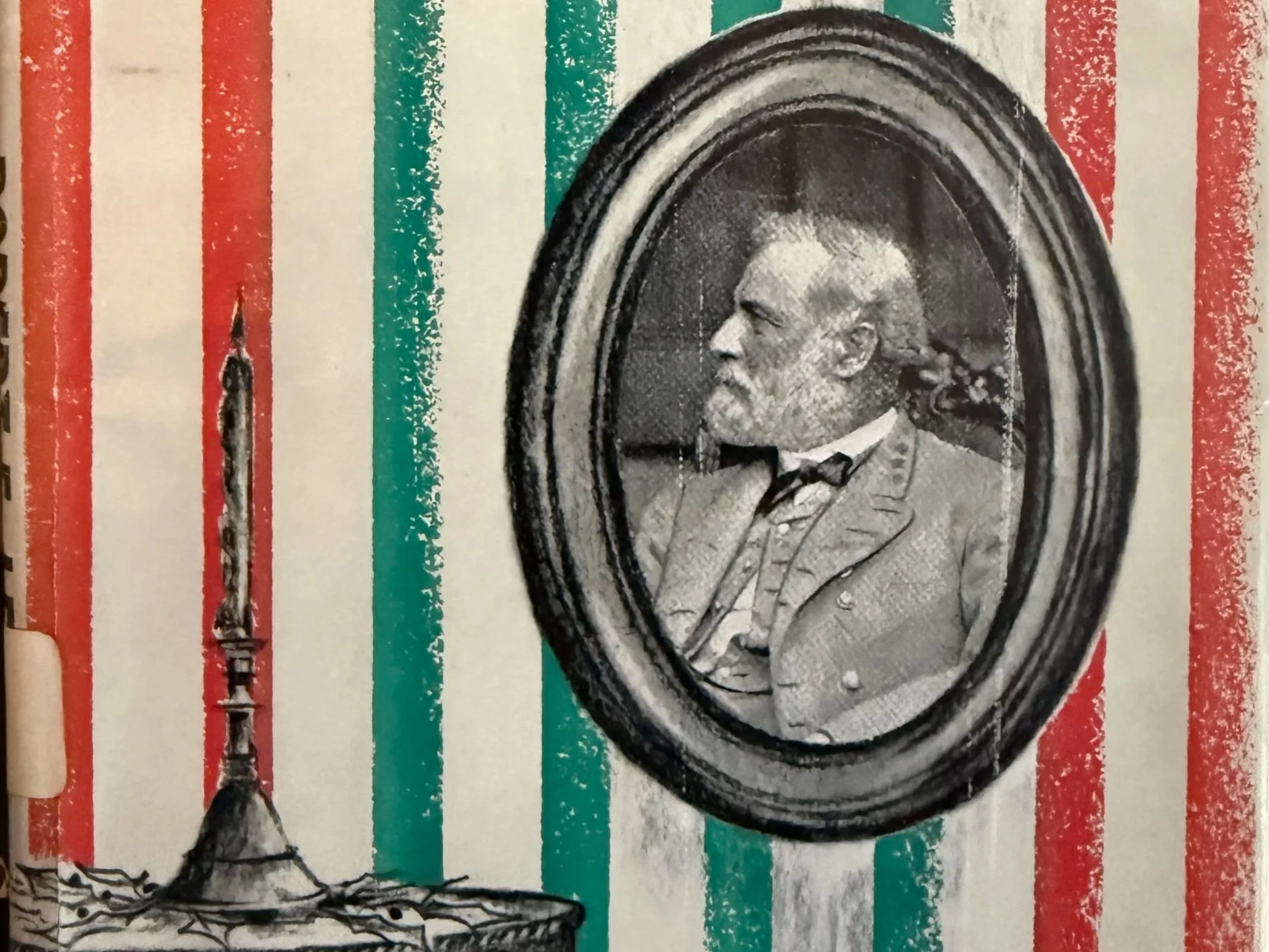
Reflection by REL Jr.:
The Christmas of 1867 I spent, as usual, in Lexington with my father. He had been president of the college now a new little more than two years. The number of professors and students had largely increased. The chapel had been built, many improvements made to the lecture- rooms and halls, the grounds improved by the laying out of roads and walks, the inclosures renewed, the grass restored to the campus, and new shade trees set out over the college grounds. The increase in the number of professors demanded more houses for them.
As a move in this direction, the trustees decided to build a new house for the president, so that the one he now occupied could be used for one of the faculty. Accordingly, the appropriation of a sum was made, and my father was authorised to build according to a plan of his own selection. He took a keen interest in this matter, and at once commenced designing a new "President's House" on the lot which had previously been occupied by an old building devoted to the same purpose. This house was completed in the summer of 1869.
The endowment fund of the college had been increased by liberal contributions from several philanthropic persons, and also by a better investment of the resources already belonging to the institution. The fees from the greater number of students also added much to its prosperity. His interest in the students individually and collectively was untiring. By the system of reports made weekly to the president, and monthly to the parent or guardian, he knew well how each one of his charges was getting on, whether or not he was progressing, or even holding his own. If the report was unsatisfactory, the student was sent for and remonstrated with. If that had no effect, the parents were advised, and requested to urge the son to try to do better. If the student still persisted in wasting his time and money, his parents were asked to call him home.
As illustrating how well the president was acquainted with the students, and how accurate was his remembrance of their individuality, it is related that on one occasion a name was read out in faculty meeting which was un- familiar to him. He asked that it be read out again, and repeated the name to himself, adding in a tone of self-reproach : " I have no recollection of a student of that name. It is very strange that I have forgotten him. I thought I knew every one in college. How long has he been here?" An investigation proved that the student had recently entered during his absence, and that he had never seen him. He won the confidence of the students, and very soon their affections. He regarded a mass of petty regulations as being only vexatious, and yet by his tact and firmness his discipline became most effective. Very seldom was there any breaking of the laws. He was so honoured and loved that they tried to please him in all things.
(pg. 294-5 of Recollections and Letters of General Robert E. Lee)
Letter written by REL to his son WHFL about son’s Christmas gift to him:
"Lexington, Virginia, February 26, 1867.
My Dear Fitzhugh:
You must not think because I write so seldom that you are absent from my thoughts. I think of you constantly, and am ever revolving in my mind all that concerns you. I have an ardent desire to see you re-established at your home and enjoying the pleasure of prosperity around you. I know this cannot be accomplished at once, but must come from continuous labour, economy, and industry, and be the result of years of good management. We have now nothing to do but to attend to our material interests which collectively will advance the interests of the State, and to await events. The dominant party cannot reign forever, and truth and justice will at last prevail. I hope I shall be able to get down to see you and Rob during the next vacation. I shall then have a more correct apprehension of existing circumstances, and can follow your progress more satisfactorily. I was very much obliged to you for the nice eye-glasses you sent me Xmas, and asked your mother and the girls to thank you for them, which I hope they did.
I fear they are too nice for my present circumstances, and do not think you ought to spend anything, except on your farm, until you get that in a prosperous condition. We have all, now, to confine ourselves strictly to our necessities. . . .
While you are your own manager you can carry on cultivation on a large scale with comparatively less expense than on a small scale, and your profits will of course be greater. I would commence a system of progressive improvement which would improve your land and add steadily to your income. I have received, lately, from Fitz Lee a narrative of the operations of his division of cavalry. I requested Custis to write to you for a report of your operations during the winter of 1863-4 down to April 18, 1865. How are you progressing with it? I know the difficulties of making such a narrative at this time; still, by correspondence with your officers, and by exerting your own memory, much can be done, and it will help me greatly in my undertaking. Make it as full as you can, embracing all circumstances bearing on the campaigns affecting your operations and illustrating the conduct of your division. I hope you will be able to get up to see us this spring or summer. Select the time when you can best absent yourself, that you may feel the freer and enjoy yourself the more.
… I wish I were nearer to you all. Your mother is about the same, busy with her needle and her pen, and as cheerful as ever.
Affectionately your father,
R. E. Lee.