
Who Speaks for Alumni in the Presidential Search?
April 14, 2026
(Sketch of the Washington and Lee Colonnade, drawn for the 1895 Calyx, featuring Newcomb Hall before the addition of front columns. Original Trident logo overlaid by TGR.)
Yesterday, The Generals Redoubt (TGR) met with the Presidential Search Committee to advance its position on the future leadership of Washington and Lee University. Principal among the concerns raised was one of alumni representation and transparency.
We are grateful for the outreach they provided us with in yesterday’s setting, one of many listening sessions they are hosting with various university stakeholders and interest groups.
Despite these efforts, however, there is no denying that alumni receive inadequate representation within university decision-making. For example, the Search Committee’s oldest graduate — and the only from that decade — is from the Class of 1983. Of the ten alumni on the committee, all serve the university in official capacities. Trustees constitute the majority of the seventeen-member group, while faculty and senior administrators together make up a close second. In effect, the committee is composed almost entirely of individuals who are institutionally embedded, with zero representation from alumni whose primary relationship to Washington and Lee is as graduates.
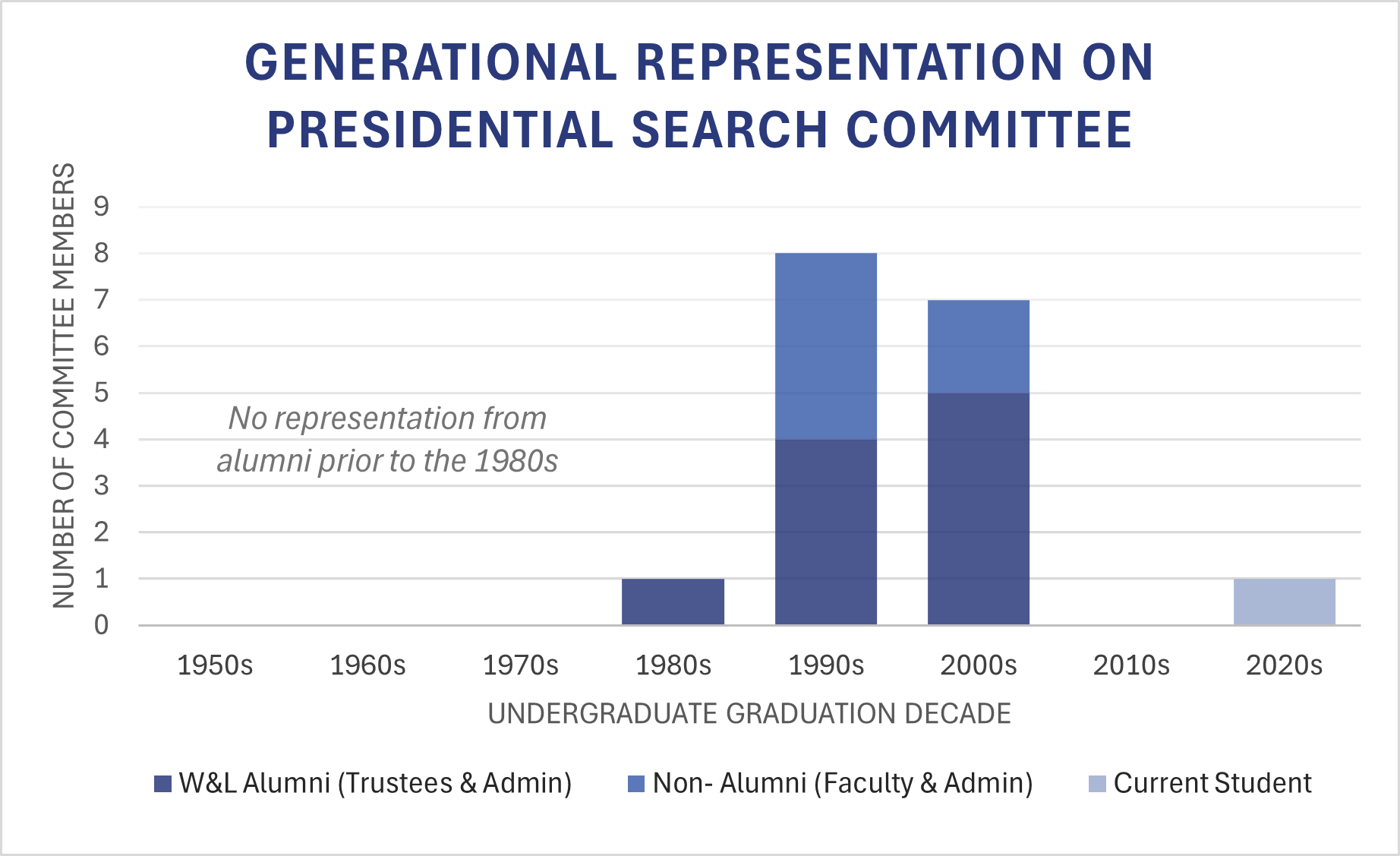
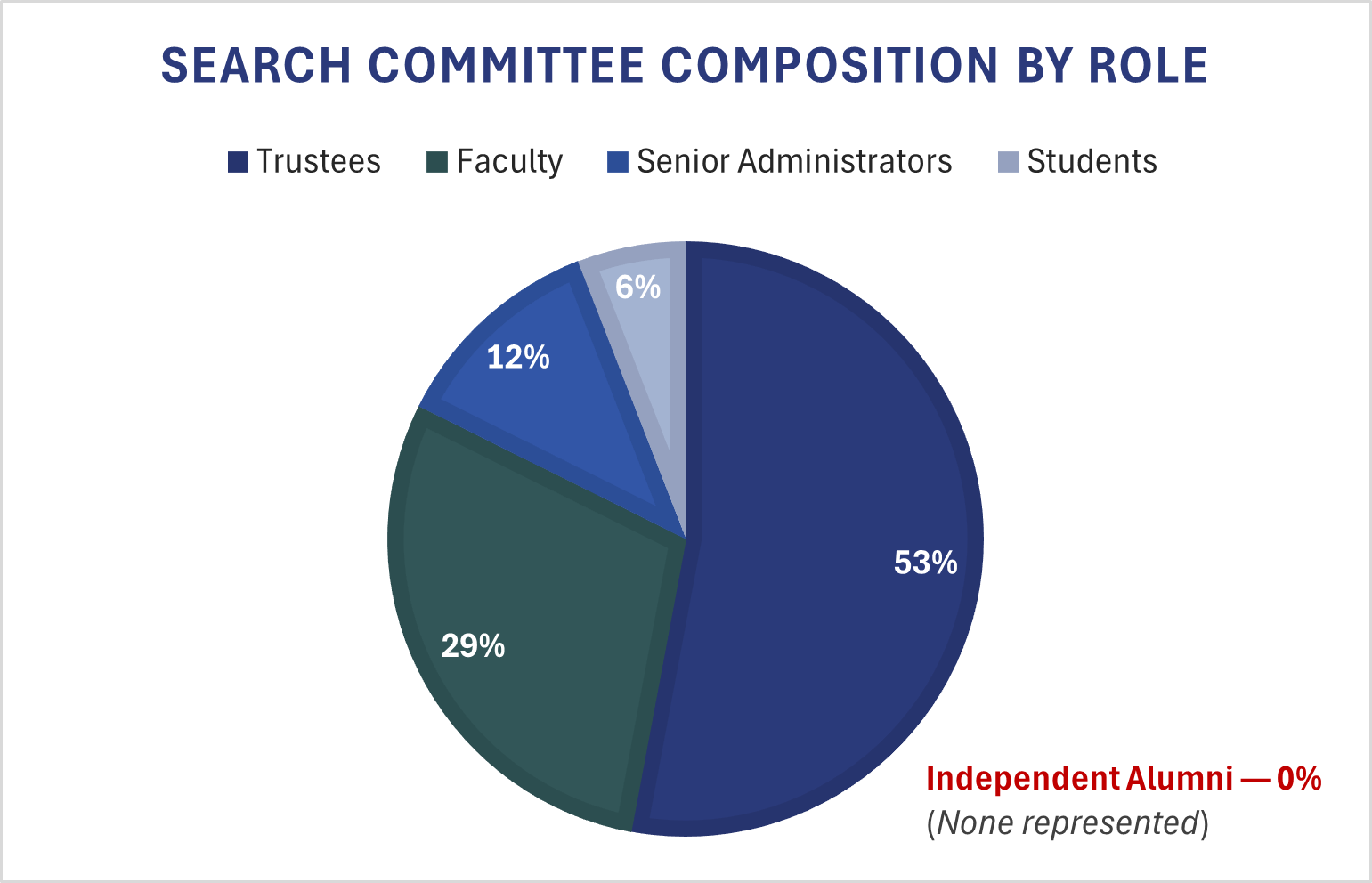
(10 alumni are on the committee, all serve as trustees or university officials. The committee consists of 17 total members. Three administrative staff are excluded from these charts, as they do not serve as decision-making members.)
This distinction matters. Alumni who are not employed by or formally tied to the university bring a broader generational perspective and an independence of judgment shaped by their experiences beyond the university’s internal leadership circles. Independent alumni remain deeply invested in Washington and Lee’s success, as donors, ambassadors, and stewards of its reputation. But they are uniquely positioned to offer candid insight into how the institution is perceived and experienced outside its leadership circles. A search process that lacks these voices risks becoming insular at precisely the moment when clarity, accountability, and long-term vision are most needed.
This concern was echoed in our conversation with the committee, where it became clear that, while alumni input is being gathered, it remains limited in both scope and depth. When asked whether the committee planned to host alumni listening sessions in various cities or virtually, for example, the committee chair responded that they would seek to gather opinion only if it were “within practical” means. That represents a missed opportunity, one that can still be corrected.
Alumni representation should not be confined to a narrow slice of recent decades or to a limited number of overly structured engagements with select interest groups. Representation should reflect the full breadth of the Washington and Lee community — from the 1950s and 1960s through the present day — each generation bringing its own perspective on what the institution has been, and what it ought to become.
Members of the university community have already demonstrated the importance of broader engagement. At The Generals Redoubt’s inaugural Franklin Society debate at Fancy Hill, student and faculty participants considered whether alumni should play a greater role in the governance of the institution. Most participants agreed, holding that those with a lasting stake in the university’s future ought to have a meaningful voice in its direction.
This engagement must subsequently be paired with transparency. The university has taken steps to solicit alumni feedback, including through its recent survey. According to the committee, they have received some 2,000 responses, a testament to how the Washington and Lee community is not unmindful of the future.
When asked whether the results of the survey would be published, the committee indicated that they would incorporate the feedback into their presidential profile, but the underlying results would not be made public. This approach falls short of what transparency requires. The structure of the survey — composed largely of discrete, quantifiable responses — lends itself to clear reporting. Publishing aggregated results, such as the percentage of respondents identifying key concerns and priorities, would provide meaningful insight without compromising confidentiality or overburdening the search process.
For these reasons, The Generals Redoubt calls on the university to take two concrete steps. First, to publish the results of its survey in an anonymized, aggregated format. This allows everyone to understand the perspectives that have been shared, and builds trust in a process whose composition does not reflect the breadth of the community it serves.
Second, we call for the committee to host accessible and varied public forums for the university’s constituents. These forums provide a space for questions, dialogue, and continued engagement as the process moves forward.
For our part, The Generals Redoubt will continue to promote the search process. We will host additional listening sessions, gather alumni feedback, and ensure that those voices are elevated. We have also launched a dedicated webpage on the presidential search process, where we will continue to publish official updates, TGR analysis, historical examples of presidential leadership, and alumni letters.
We were encouraged to learn that the university is likely to appoint an interim president to allow for a more deliberate and thorough search process. This would be a welcome step. In recent years, the university has made several decisions under compressed timelines that have not yielded durable outcomes. The selection of a president warrants a different approach, one defined by patience, transparency, and a willingness to meaningfully consider the Washington and Lee community. If approached in this way, the process will not only produce a stronger outcome, but one that commands the confidence of those it is meant to serve.
Sincerely,
Stephen W. Robinson, ‘72, ‘75L
President
The Generals Redoubt