
A Day of Mourning…Of Hope and Joy (1968)
[The speech marks President Huntley’s first commencement address, given only a day after the death of Senator Kennedy. Huntley encouraged students to practice mindfulness with a “good mind” and knowledge of history amid the turbulent times. For more information, please visit W&L Special Collections.]
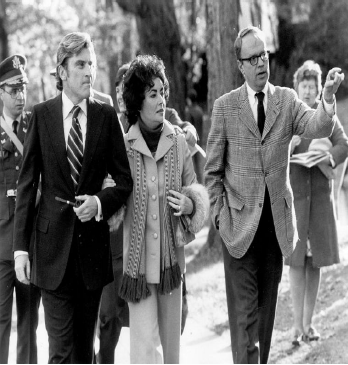
(President Huntley | SOURCE: W&L Spectator)
Among the many customs at Washington and Lee, there is one in particular which concerns me and you at this moment. It is the custom that the President of the institution deliver the remarks at commencement. I'm confident that the original reasons for this custom were twofold: one—Washington and Lee’s presidents would be, it was assumed, splendid orators; two—the President could, by delivering the remarks himself, enhance brevity in an already lengthy ceremony. Both these assumptions have proven valid—until this time. Now one of them has been vacated. I wish to assure you in advance; however, I shall not fail to preserve the other.
Several weeks ago, at your Senior Banquet, I expressed to you the sentiment that those of us whose business it is to remain here are likely to feel we have a kind of claim on you, a stake in your lives. It’s a presumptuous sentiment, perhaps, but not a surprising one, because if we did not harbor this thought, it is not probable that we would wish to be here at all.
So, whether you acknowledge it or not, many of us here will see your successes and your failures as partly ours and will rejoice in the one and sorrow in the other.
So, also, we have certain hopes about you, hopes that you will take from this place qualities of real value which you have nurtured and developed, at least in part, during your time here.
Most basic, perhaps, there is the hope that you will take with you the makings of a good mind, a habit of thought which is both disciplined and independent. It has been remarked—and correctly so—that education is a radical act, an act which cuts the mind loose from old bondages, releasing it to question and to probe and to reformulate. But education is also, of course, a process of conservation. It conserves the values of the past and strives to provide a nexus between the generations and between the ages. In a recent article by Edgar Dale, in which he spoke of the good mind, he said this: “A good mind does not reinvent the alphabet or the wheel. It starts its hard work where others left off. It stands on the shoulders of the giants of the past. A good mind requires the chastening influence of a sense of history.” Or, as Santayana put it, “Those who cannot remember the past are condemned to repeat it.”
Education aims to conserve the resources of the mind itself. It forces a confrontation with the past, invites a substitution of new directions for old fetters, and thus frees the mind for its inevitable confrontation with the future.
I would hope you take with you the makings of a mind which can maintain the delicately balanced position between irresolution and dogmatism. As Dr. Gaines once put it, “Open-mindedness can become mere empty-mindedness, as if the mind were open at both ends so that all the circumstantial breezes of fresh opinion may blow through at will and sweep out every vestige of certainty.”
The closed mind is worthless; the wholly open mind stands like a jackass between two bales of alfalfa and chews dead weeds.
I would wish for you, therefore, a mind which can close on a core of conviction, a mind which is tolerant—not the kind of tolerance which is in fact no more than condescension, but rather the kind of tolerance which recognizes the possibility of error and, even more important, recognizes that there is always more than one path to truth. The mind with this kind of tolerance does not work to destroy, but rather to create or to strengthen those institutions in society which may exist primarily to accommodate opposing convictions and effect a resolution which does not represent perfectly any of the components which produced it.
And I would wish for you also a quality of spirit which will insulate you against despair, against hopelessness. The despair to which I refer evidences itself in different forms. On the one hand, it may result in a withdrawal, a turning away, a turning inward, or, turning off—a despondency which gazes on life with dull disinterest or which plunges only into some mock creation.
On the other hand, despair may produce a kind of frenetic involvement. It produces, I believe, one of the notable anomalies of our time—the deep conviction, lightly chosen, lightly held, and lightly discarded.
The good mind is itself the best insulation against despair because it knows also the limitations of the intellect. It knows that its core of conviction will in part remain forever undemonstrated. In short, it knows the meaning and the place of faith.
This is a day of mourning for that national leader whose tragic death is uppermost in the consciousness of all of us. It is too, I would suggest, a time to mourn that bit-of-the-soul of this nation which withers with each new manifestation of bitterness and mindlessness which occurs among us.
I would say to you men of the graduating classes that it is also a day of hope and even of joy—and that it is entirely appropriate that it should be so. For here and now, at this time and place, it is your day, the day on which we, in ceremonial fashion, give expression to our hopes for your future; and, through you and others like you, to our hopes for the future of us all. Because we do not expect our hopes in you to be disappointed, it is a day of joy.
I wish you well.