
Dr. Douglas S. Freeman Delivers Founder’s Day Address (1927)
[On Lee’s 120th birthday, Douglas S. Freeman offers remarks on Lee’s time at Washington College and his impact on the school. For more information, please visit Washington and Lee Special Collections.]
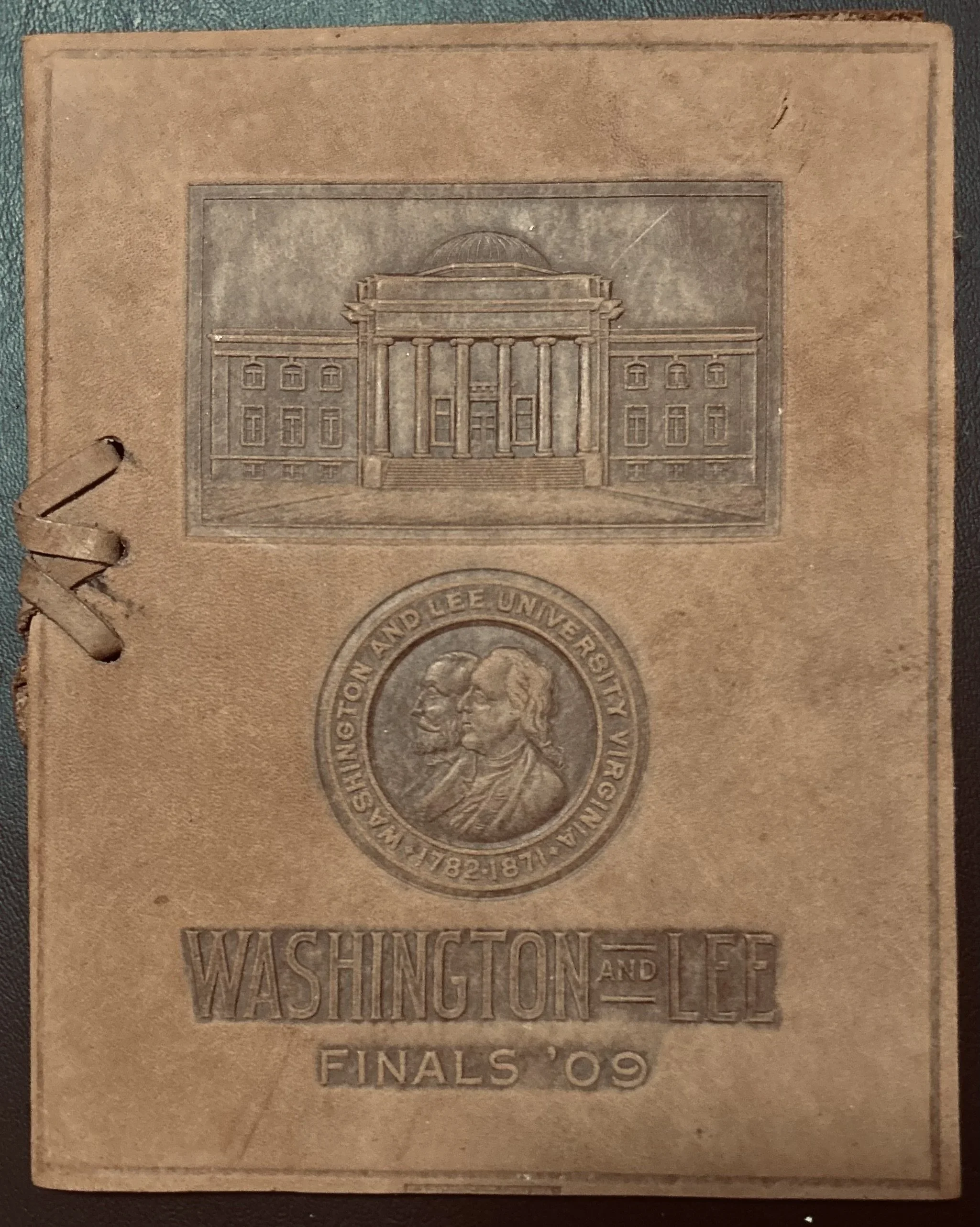
(1909 graduation pamphlet | SOURCE: W&L Spectator)
Speaking from a new viewpoint, not what Lee did for Washington College, but what his years at Washington College meant to General Lee, Dr. Douglas S. Freeman, editor of the Richmond News-Leader, delivered an interesting and absorbing address at the celebration of Washington and Lee Founder’s Day. The celebration was held in Doremus gymnasium on the 120th anniversary of Lee’s birth, and on the day, as Dr. Freeman reminded his audience, set aside by the trustees of Washington College as a day to commemorate Lee, at the meeting held just after his death when Washington College became Washington and Lee University.
General Lee’s five years at Washington College, said Dr. Freeman, brought complete final conquest of his own spirit. He spoke of the human and natural feelings of the great general following Appomattox, his distress for the South, his indignation at the imprisonment of Jefferson Davis, his apprehensions for his family, his desire to vindicate himself and his army. The absorption of his work at the college and its softening influences completely shadowed and allayed the unrest in his soul.
Dr. Freeman gave striking instances of the self-conquest of his spirit in the shouldering and mastering of the details of his office, details which were irksome to him, without even the aid of a secretary.
The work of his office here, as Dr. Freeman showed, absorbed his mind and kept him from brooding over the War between the States. The stage of resentment soon passed, and his intention to write a book of vindication soon faded into oblivion. The speaker gave interesting illustrations of how completely General Lee entered into the work of his college. He delighted his young hearers with stories of how students were expelled for taking excursions to Natural Bridge, how General Lee attended classes and examinations. On one occasion, Dr. Freeman said, General Lee met a student whose work was falling behind, and he saluted him with the remark that he must be very fond of his mother, as he took such good care of her son.
The last years of General Lee at Washington College brought happiness to him. They should be known as his happy years. The great man had two heavy weights on his soul: the imprisonment of Jefferson Davis and his distress for the South and its people. The release of Davis brought joy to him, and an instance graphically described by Dr. Freeman lifted the load of his sorrow from his heart. This was the occasion of his visit to Petersburg in 1867 for the marriage of his son, General Rooney Lee.
Dr. Freeman expressed General Lee's reticence to travel and to stir up in the hearts of his people the recollections of the sorrows of war. When prevailed upon to go to Petersburg, the journey brought up in his mind the days of his campaigns in the fields that he passed as he journeyed along. His striking reception from his old soldiers at Petersburg, the expressions of love, confidence and hope on their faces saw a turning point in his life, and he returned to Lexington with his vigor renewed and a great weight lifted from his soul at the spirit of his countrymen to conquer the new and trying days of the aftermath. The legend that General Lee died of a broken heart, said Dr. Freeman, is a myth, for his soul was too great and his faith too deep to be broken by any happening on this earth.
He closed with a graphic incident showing the spirit of Lee “to deny himself.” Previous to the address, President Henry Louis Smith read his annual report on the progress of the University during the past year.