
Kiffin Rockwell Portrait Unveiled (1937)
[The following 1937 Alumni Magazine pays homage to Kiffin Rockwell, ‘13, for his courageous service in World War 1. For more information, please visit W&L Special Collections.]
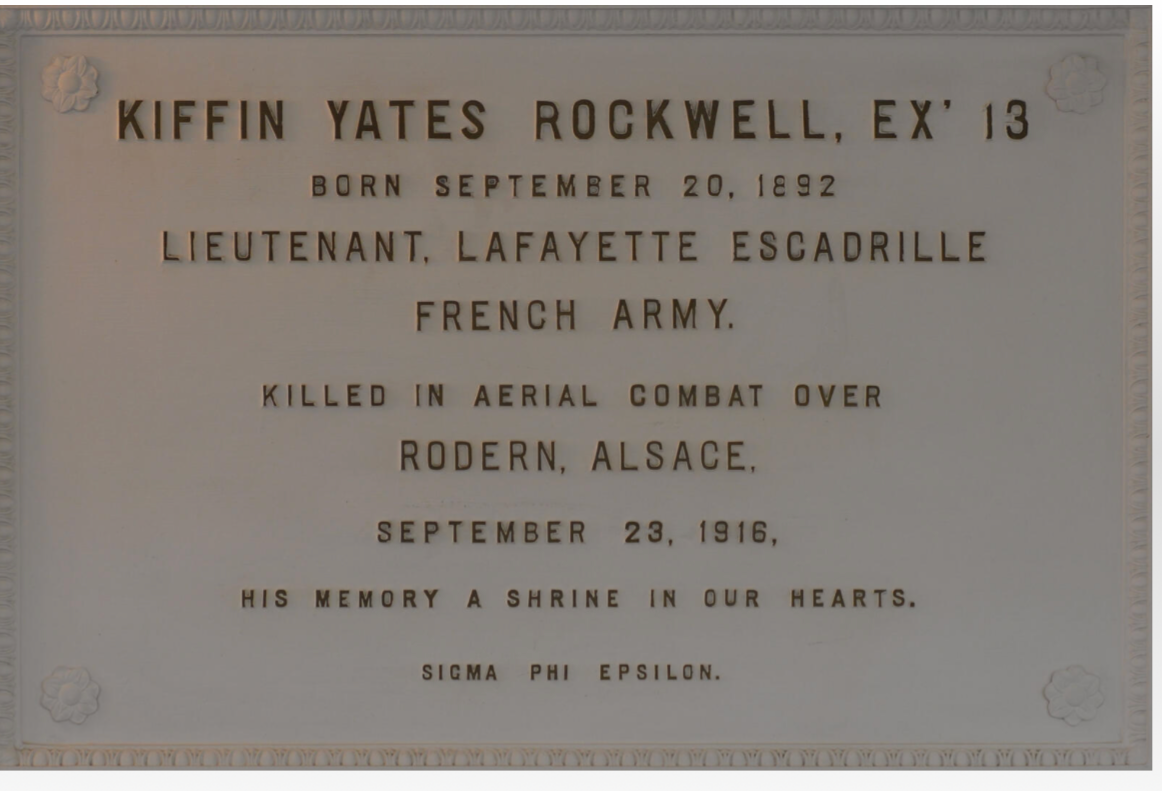
(Tribute plaque to Kiffin Rockwell, erected in the Lee Memorial Chapel in the early 1920s. University officials removed it in 2021 and reinstalled it on the Veterans Memorial Arch on Jefferson Street. | Source: Washington and Lee)
On the twentieth anniversary of the death of the first American to enter the World War, the first Southerner to die in action, a band of citizens gathered in the Hall of the House of Representatives at Raleigh, North Carolina for the presentation by the Rockwell family of a portrait of Kiffin Rockwell, '13.
Paul A. Rockwell, '12, the soldier’s brother presented the portrait.
The speaker reviewed the “brief but glorious” career of Kiffin Rockwell, born at Newport, Tennessee, September 20,1892, the son of the late James Chester Rockwell, a well-remembered North Carolina poet and writer and Loula (Ayers) Rockwell. Kiffin Rockwell was born a soldier. A direct descendant of William Rockwell, of Fitzhead, England, who came to America in 1630, his ancestors fought in most of the colonial wars mentioned in American history. Seven Rockwells were officers in the War of the American Revolution. Kiffin's two grandfathers were Confederate officers, Henry C. Rockwell a Captain in the 51st North Carolina Regiment, and Enoch Shaw Ayers in the 8th South Carolina Volunteers, C. S. A. He played “war” as a child with his brother and other boys, in the foothills of the Great Smoky Mountains in East Tennessee, and on his grandfather Ayers’ plantation in South Carolina, where he spent much of his boyhood.
Kiffin Rockwell attended first the Virginia Military Institute, then Washington and Lee University, where he became a member of Virginia Epsilon chapter, Sigma Phi Epsilon. His fraternity membership was precious to him all his life. He received an appointment to Annapolis, but resigned it after a few months of preparatory study, feeling that the United States Navy might never see action. On the morning of August 3, 1914, the day that Germany declared war on France, Kiffiin Rockwell wrote the French Consul-General in New Orleans, asking how to go about joining the French Army, “If my services can be used by your country, I will bring my brother, who also desires to fight for France.”
The two brothers sailed for France August 7, 1914, on the American Line vessel St. Paul. They joined the French Foreign Legion immediately upon their arrival in Paris, and were both wounded some time later. Kiffin was shot through the thigh by a machine gun bullet during a bayonet charge at Vimy Ridge May 9, 1915. His wound incapacitated him from marching, so he asked to transfer to the French Air Service then beginning to accept American volunteers. Paul Rockwell was wounded in the shoulder so severely that he went back to French Army Grand Headquarters as official war correspondent. He remained in France, and during the 1925 war in Morocco against the Riff tribes he served as captain of the 37th French Aviation Regiment.
In April 1916, Kiffin was one of the founders of the unit of American volunteer aviators, which later became the famous Lafayette Escadrille. In his first encounter with a German aero plane, May 18, 1916, he shot down in flames the enemy machine, the first aerial victory ever won by an American aviator. A week later, flying over Verdun, where the greatest battle in history was raging, he was severely wounded in the face by a German explosive bullet, during an air duel in which he shot down his opponent. He refused to enter the hospital for treatment, had his wound dressed and continued to fly.
Marshal Joffre decorated Kiffin Rockwell with the Military Medal and the Croix de Guerre. He remained at Verdun throughout the summer of 1916, winning numerous victories, decorations, and promotions. During the month of July 1916, his official record showed that he engaged in more air battles than any other pilot in the French aviation.
Early in September, the Lafayette Escadrille was ordered to Alsace, where aerial activity was intense. He was given a new Spad aero plane, the fastest type seen over the front up to that time, mounted with two machine guns. Rockwell took his Spad over the lines to try it out early in the morning of September 23, 1916.
Just inside the French lines, he sighted a huge German two-seater observation plane. He immediately dived to attack it, holding his fire until close up. A German bullet tore a great hole in his chest and his plane sped downward, falling in a field of flowers just within the French lines. The enemy artillery opened fire on it, but French artillerymen rushed from their shelters and dragged the aviator’s broken body from the wreckage of his plane.
Kifin Rockwell was buried at Luxeuil-les-Bains, where his escadrille had its headquarters. He was given a funeral worthy of a general, officers and men of the Allied Armies marching behind the artillery caisson that bore his remains to their last resting place.
Sergeant James Rogers McConnell, Kiffin's comrade who also met a hero’s death, March 19, 1917, wrote in “Flying for France,” the following tribute to Kiffin Rockwell:
“The news of Rockwell's death was telephoned to the escadrille. The captain, lieutenant, and a couple of men jumped in a staff car and hastened to where he had fallen. On their return the American pilots were convened in a room of the hotel, and the news was broken to them. With tears in his eyes the captain said: ‘The best and bravest of us all is no more.’
No greater blow could have befallen the escadrille. Kiffin was its soul. He was loved and looked up to not only by every man in our flying corps but by everyone who knew him. Kiffin was imbued with the spirit of the cause for which he fought and gave his heart and soul to the performance of his duty. He said: ‘I pay my part for Lafayette and Rochambeau,’ and he gave the fullest measure. The old flame of chivalry burned brightly in this boy's fine and sensitive being. With his death France lost one of her most valuable pilots. When he was over the lines the Germans did not pass—and he was over them most of the time.”
Kiffin Rockwell’s name is revered in France as it is in America. The late Theodore Roosevelt referred to him as “a Lafayette of the air.” Flying fields and aviation schools have been named for him; poems have been written to him; the Asheville, N. C., Post of the American Legion bears his name as does the Post of Veterans of Foreign Wars at Newport, Tennessee. His name is engraved on the walls of the Pantheon in Paris, the Lafayette Escadrille Memorial monument, and the monument to the American volunteers who died for France which stands in the Place des Etats-Unis, Paris. Over his grave at Luxeuil-les-Bains, the townspeople of the little city where he is buried have placed a handsome bronze memorial tablet. Another handsome bronze tablet to his memory was placed in the Robert E. Lee Memorial Chapel on the Washington and Lee University campus, by Virginia Epsilon chapter, Sigma Phi Epsilon. His “War Letters” were published in book form in 1925, by Doubleday.