
Fatherly Advice from Henry Lee (1816)
[The following are pulled from a series of letters Henry Lee wrote to his son Charles Carter Lee. While in exile, Lee offers wisdom and insight to his eldest son. For more information, please visit Fancy Hill to see the whole collection.]
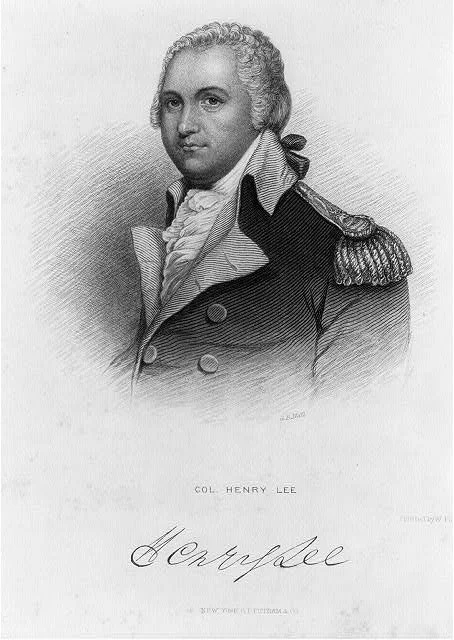
(Col. Henry Lee III | Source: Library of Congress)
Port-au-Prince, St. Domingo, June 26, 1816.
My Dear Carter, —I have just heard by a letter from Henry that you are fixed at the University of Cambridge, the seminary of my choice. You will there have not only excellent examples to encourage your love and practice of virtue, the only real good in life, but ample scope to pursue learning to its bottom, thereby fitting yourself to be useful to your country and to be an ornament to your friends.
You know, my dear son, the deep and affectionate interest I have taken in you from the first moment of your existence, and your kind, amiable disposition will never cease enjoying and amplifying your father's happiness to the best of your ability. You will do this by preferring the practice of virtue to all other things; you know my abhorrence of lying, and you have been often told by me, that it led to every vice and cancelled every tendency to virtue. Never forget this truth, and disdain the mean and infamous practice. Epaminondas, the great Theban, who defended his country when environed by powerful foes, and was the most virtuous man of his age, so abhorred lying that he would never tell one even in jest. Imitate this great man and you may equal him in goodness, infinitely to be preferred to his greatness. I am too sick to continue this discussion; though I begin to hope I may live to see you, your dear mother, and our other sweet offspring. I only write now to require that you write monthly to me. Send your letters by vessels from Boston which go to Turk's Island for salt; and enclose them to Mr. Daniel Bascombe, merchant. He will send them to me wherever I may be, though I shall not get them as expeditiously as my heart desires. This goes to Mr. Wm. Sullivan, a gentleman of Boston, who will send it to you, and do you any necessary favor, should sickness or accident render such favor requisite. He is, too, an exemplary gentleman, worthy of your imitation. There is a little boy, James Smith, son of a Mr. Smith of these islands, at school at Westfield, not far from Cambridge; should you ever go that way call and see this boy, and assist him by your advice and countenance. He is in a strange land and far from his relatives. My prayers are always offered to Almighty God for the protection of my darling Carter, and especially for establishing in his heart and conduct virtue in all its power. I pray you never to forget that virtue is our first good and lying its deadly foe.
Your father,
H. Lee.
Nassau, May 5, 1817
Having within a few days, my dear Carter, received letters from home, yours of February last was enclosed by your dear mother. Your defense of your favorite Milton is entitled to much consideration, although it approaches to literary impiety, when you approximate him so close to Homer; but it cannot remove the objections I have to your poet, nor arrest my preference of Pope. 'Homo sum; humani nihil a me alienum puto.'' Had Milton condescended to treat of men, —and their history affords untried subjects fit for epic poetry in abundance, —I should have perused his works with delight, though not with Homeric rapture, and might have classed him with the first of English poet; but as he has preferred angels to men, my ignorance of that order of beings and their theatre of action deprives me of the capacity to perceive the poet's beauty and to decide upon the merits of his poem. Indeed, travelling with him, terra incognita, I become weary; and shut up the book, to be opened only by those who can comprehend celestial personages and celestial battles.
I never could read a novel, because it was the narrative of imaginary action; and yet I have seen many grave men and pious ladies bedew their cheeks and exclaim, ' How natural, how affecting!' with Fielding in their hand. Paradise Lost is to me alike distasteful; and I must adhere to Pope, because he treats of man and his ways. In one of my letters I urged you to acquire French, not only to read, but to speak; and I now renew my advice with anxious zeal. If you could only thereby be benefited with the perusal of Eacine, you would be liberally rewarded. Sophocles, Euripides, in Greek; Eacine, and Voltaire's Henriade, in French; are enough to invest your young mind with true taste, even had the immortal Homer and his coadjutor Virgil been lost to man.
But there is another matter which very much affects my heart, and which I have glanced at in some of my letters, the acquirement of complete self-command. It is the pivot upon which the character, fame, and independence of us mortals hang. Turn your attention steadily and closely to this cardinal quality, and habituate yourself at once to reject with disdain every temptation which may assail your self-dominion. Thus are the passions, the appetites, the cravings subjected to reason, and thus does weak man humbly assimilate himself to his Almighty Creator. Encircled as were Alexander and Scipio by the glories of the field and the cabinet, their self-command evinced on the most trying occasions, —when even beauty, the most captivating, and in their power by the right of conquest, was sheltered from the rude touch of passion, —threw around their names the splendor of virtue which overshadowed all their glory.
What breast is so callous to noble feelings as not to pant to be called their rivals? In one road only is the youth to walk whose mind is thus ennobled. He must begin with himself when young, and as his occupations at that period are of the inferior sort, he can only become a true disciple of future glory by watching his tongue and his purse. Let not the first utter a word injurious to truth, decency, or to another's peace; and never suffer want or temptation to induce the wanton disbursement of the last, but take up the determination to spend only what is absolutely necessary, and thus assume the habit of retaining part of your pecuniary allowance for casualties to which your own body is liable, and another part to enable you to help a friend when afflicted with distress. That you may at once begin and travel on to the goal under your father's guidance, ascertain exactly the sum necessary for your next year, specifying the several items; and record from week to week every expression actuated by passion, and its consequences to truth, decorum, and another's peace.
Thank you for Henry's address to his district; it does honor to his political principles, as well as to his literary talents. By a letter lately from him, he is married and I hope happily. I shall have another daughter to embrace and admire when I get home. Lucy also wrote to me; by which I learn the fate of Woodstock, and Mr. Carter's removal to Philadelphia.
But all those dear to me, —all thanks to great God, —were well, unstained by follies even, much less by offences against morality. Adieu, my beloved son. Your affectionate father,
H. Lee.