
Memorial Tribute to Rev. George A. Baxter (1846)
[The following is an excerpt from Washington and Lee Historical Papers. This excerpt highlights an article from the Staunton Spectator extolling Rev. George Baxter’s character following his death. For more information, please visit Washington and Lee Historical Papers.]
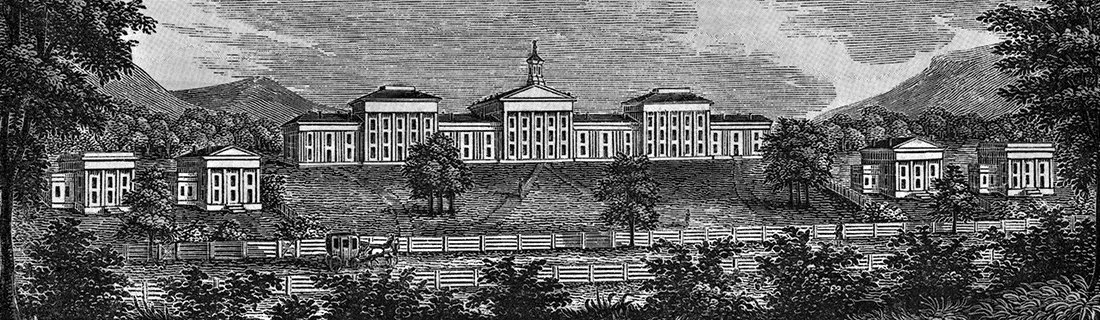
(Old Colonnade | Source: The Generals Redoubt)
It is deeply to be regretted that no one has undertaken to furnish the community with a sketch of the life and character of the Rev. George A. Baxter, D. D., a man to whom this institution owes a great deal, and whose memory deserves to be venerated by all its Alumni.
Permit one who has enjoyed the inestimable privilege of sitting under his ministry eight years, seven of which he was a member of his church, to close this number with a brief sketch of his character. Dr. Baxter was descended from respectable parents who resided in Rockingham County, Virginia, where he was born July 1771. At an early age he manifested a strong attachment for literary pursuits. And whilst yet a young man, having undergone a great change in his religious views and feelings, he resolved to make a full surrender of himself to God and prepare for the work of the holy Ministry. He was a pupil of Mr. Graham and graduated at the ‘Log College’ before it received the name of Washington Academy. He was President of Washington College more than thirty years, and Pastor of the Presbyterian Church at Lexington thirty-three years. I do not disparage Dr. Baxter’s able, pious, and learned co-adjutors and successors either in this College or Church, when I say that both owe a debt of gratitude, and perhaps something more, to his memory, which is not likely soon to be discharged. Dr. Baxter was inaugurated Professor of Theology in Union Theological Seminary, April 11, 1832, in which office he continued until his death, which occurred April 1841.
Dr. Baxter was a great and good man. As a man of genius and a scholar, he was distinguished, as an orator and a preacher he was unsurpassed; as an instructor he was eminent and successful; and as a man and a Christian, those who know him best will be the first to speak his praise. For native powers of mind, he will be ranked among the first men in the history of our Church and Country. In the acquisition of knowledge, the efforts of his mind were singular and extraordinary. In mathematics, logic, rhetoric, history and theology, his knowledge was extensive and profound. In the entire command of his thoughts, he excelled most men. His taste was correct and refined, his judgement solid, his views comprehensive, and his reasoning faculties powerful and commanding. He possessed uncommon powers to please and instruct. His knowledge was not confined to a single science, or to one branch of literature; it was varied, profound and extensive. As a pulpit orator he had few equals and was surpassed by none. As a preacher, he was esteemed a model. His eloquence was of the most commanding, dignified, and impressive order. He was in style, taste, power, gesture, and argument, the finished and consummate orator. He was wise to win souls and was greatly successful in his efforts to bring men to a knowledge of “the truth as it is in Jesus.” The Holy Spirit honored and blessed his ministry by the conversion of many souls in numerous revivals of pure and undefiled religion. To such revivals of religion, he was an enlightened and warm friend. In a word, he was a man of devoted and fervent piety; “might in the scriptures;” mighty in the knowledge of “the faith once delivered to the saints;” mighty in the history of the Church; mighty in sound wisdom and discretion; mighty in that noble, comprehensive character given by the pen of inspiration to a minister of old— “he was a good man and full of the Holy Ghost and of faith,” and through his instrumentality “much people was added to the Lord.”
And yet, notwithstanding his greatness, he was as simple as a child, and as easy of access as one altogether unconscious of any merit. He was confiding in his friendship, sincere in his professions, and always charitable and forgiving. His humility was real, his life unostentatious, and his frame of mind devout. “He was a burning and a shining light.”
The decrease of this inestimable man called forth testimonials of respect from various institutions and ecclesiastical bodies with which he was connected. His death was a sad stroke to many a sorrowing and smitten heart. He was greatly beloved and universally lamented.
Such is a feeble outline of the character of the Rev. George A. Baxter, D. D. Thousands will attest its truth. The writer speaks what he knows and testifies what he has seen and heard.