
Remarks to the Graduates (1962)
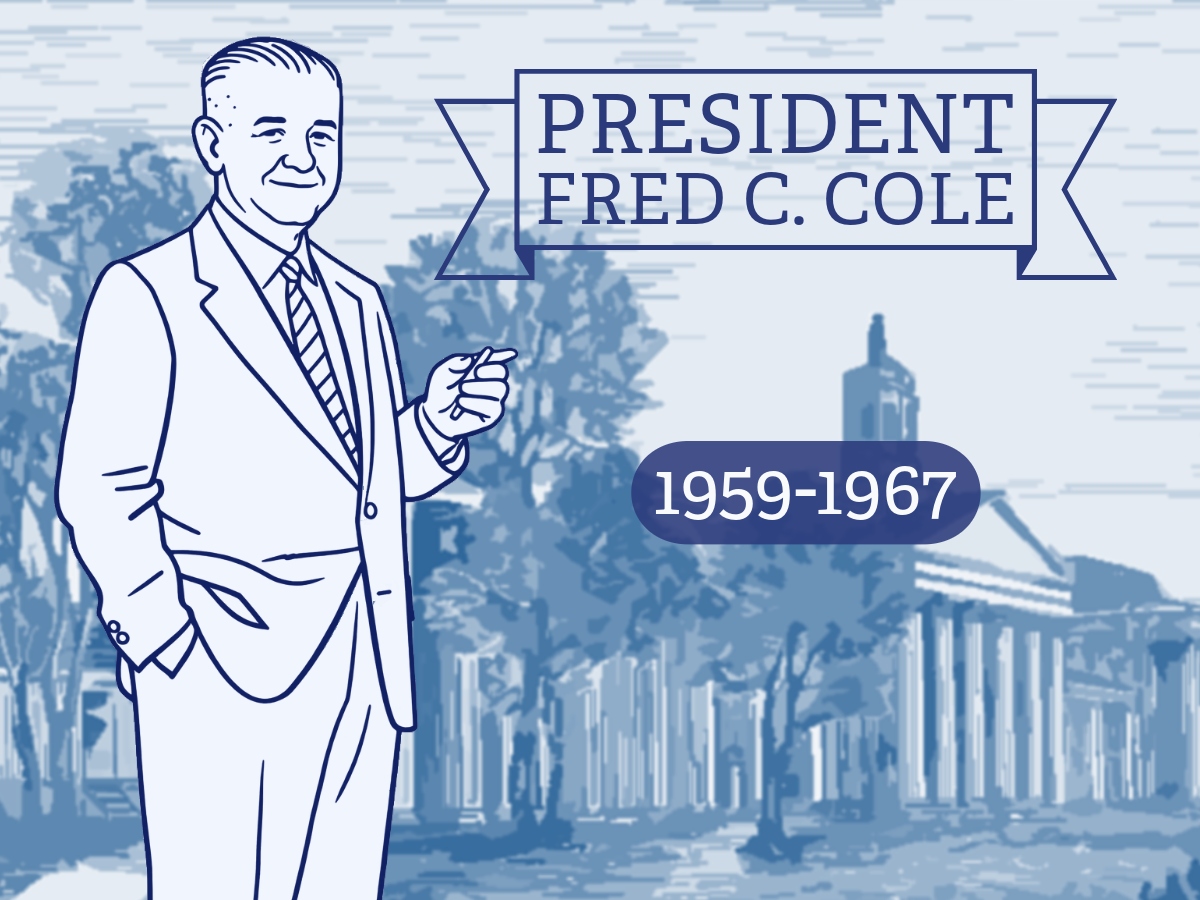
[The following is an excerpt from President Cole’s commencement speech in 1962. He discusses the role of the Honor System and honor among students at Washington and Lee. For more info, please visit W&L Special Collections.]
Perhaps as students you have tended to think of Washington and Lee’s traditions in terms of speaking on the campus walks, wearing a coat and tie, or electing a student government which administers, among other important activities, the cherished Honor System. All of these, especially the Honor System, are important, but they are not so much traditions in themselves as they are a part of the overall, historical tradition of the University that has permitted these practices and customs to develop and flourish here.
The Honor System is, after all, a derivation from the character of the honorable men who have taught and studied at Washington and Lee over a span of more than two centuries. The Honor System presupposes, not only the honor of the individual, but also a certain confidence and faith which the individual must have in his fellow man. As much or more than any other single influence, this camaraderie of honor binds the alumni of Washington and Lee into a rather unique brotherhood, regardless of their geographical origins, regardless of the special conditions which obtained when they were students on this campus.
From time to time questions arise as specific applications of the Honor System. Different generations of students may have differing concepts of a definition of honor, and may question the Honor System in terms of their definition, but I know of no conceivable challenge to the basic principles of honor.
A partner to the concept of honor which is so much a part of the Washington and Lee tradition is the concept of gentlemanly conduct and bearing by the students of this University. Certainly men of honor studied at this institution prior to the Civil War, as did men who could be called gentlemen in every sense of the word. In dating the beginning of the Honor System, however, it is appropriate to begin with General Lee’s administration, and certainly Lee’s answer to the student who asked for a book of rules provided the solid frame in which to focus the gentleman’s tradition. I know you are all familiar with his answer: “We have but one rule here, and it is that every student must be a gentleman!”
The learning process may be a little affected by whether a student wears a coat and tie to class or not. And with the one notable exception afforded by the famous Doremus incident, it is difficult to trace truly tangible results of students’ exchanging greetings among themselves and with strangers on the campus. But both of these practices represent a part of the larger tradition of gentlemanly conduct among students. And it might be said that inasmuch as these practices reflect a certain amount of self-concern and self-pride in the individual as to how he looks and how he behaves, there may be important carry-over benefits that may affect the concern and pride a student has in his scholarly achievements.
But my point is a simple and direct one: the tradition of students who are honorable and who are gentlemen is a thread that connects two hundred years of Washington and Lee men. It is a tradition that fuses with the historical tradition of the University, emphasizing the impact which the institution has had on thousands of lives as these students became in spirit and in fact a part of something that has endured and will endure. It fuses also with the tradition of service and leadership to the nation which students of Washington and Lee have rendered in war and in peace. I believe, and I am certain that you will agree, that you of the class of 1962 have been touched by the traditions of Washington and Lee, and that the influence upon you which they have had is significant. If I am to judge by what I hear from members of former generations of students, the influence these traditions have will continue to grow as you grow older.
As meaningful as these traditions may be to you even now, I believe they will become even more meaningful as your sense of value becomes more sharply defined through the maturity of active and productive lives.
There is another tradition at Washington and Lee that has touched your lives, and it is of such importance as to merit special emphasis at this time. This is the tradition of dedicated, unselfish, often seemingly tireless men who have served this University as professors, men whose lives of devotion to scholarship and teaching punctuate the record of Washington and Lee’s long history. In this instance, I do not refer to the presidents or the deans, or the other administrators—although the history of service among these men is similarly inspiring—but I speak of the teaching faculty, men whose influence is inscribed permanently on the lives of students who were their pupils and young associates in an adventure of learning.