
[The following are excerpts from General Washington’s letters to Joseph Reed, in which he details the growing movement of independence (partly due to Common Sense) and the importance of unity among the colonies. For further reading, please visit Hathi Trust Digital Library to view The Writings of George Washington. This highlight is part of our ongoing Legacies of Liberty series, where we celebrate Washington and Lee’s Revolutionary founders.]
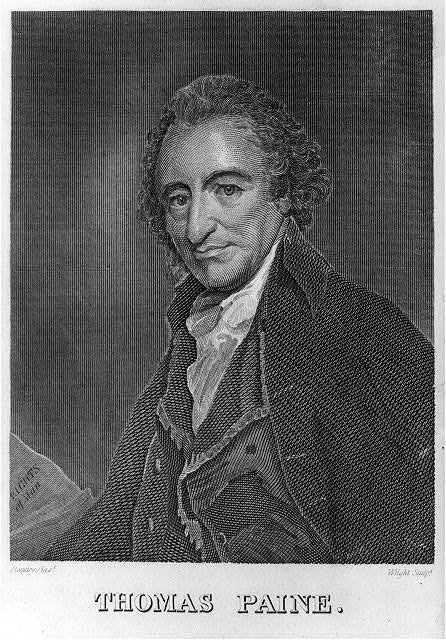
(Thomas Paine (of ‘Common Sense’) | Source: Library of Congress)
To Joseph Reed,
Cambridge, 1 April, 1776
Dear Sir,
By the express which I sent to Philadelphia a few days ago, I wrote you a few hasty lines; I have little time to do more now, as I am hurried in despatching one brigade after another for New York, and preparing for my own departure by pointing out the duties of those that remain behind me.
Nothing of importance has occurred in these parts, since my last, unless it be the resignations of Generals Ward and Fry, and the reassumption of the former, or retraction, on account as he says, of its being disagreeable to some of the officers. Who those officers are, I have not heard; I have not enquired. When the application to Congress and notice of it to me came to hand, I was disarmed of interposition, because it was put upon the footing of duty, or conscience, the General being persuaded that his health would not allow him to take that share of duty that his office required.
The officers to whom the resignation is disagreeable, have been able, no doubt, to convince him of his mistake, and that his health will admit him to be alert and active. I shall leave him till he can determine yea or nay, to command in this quarter. General Fry, that wonderful man, has made a most wonderful hand of it. His appointment took place the 11th January; he desired ten days ago, that his resignation might take place the 11th April. He has drawn three hundred and seventy-five dollars, never done one day’s duty, scarce been three times out of his house, discovered that he was too old and too infirm for a moving camp, but remembers that he has been young, active and very capable of doing what is now out of his power to accomplish; and therefore has left Congress to find out another man capable of making, if possible, a more brilliant figure than he has done; add to these the departures of Generals Lee and Thomas, taking some little account of S[pencer] and H[owe], and then form an opinion of the G[enera]ls of this army, their councils, &c.
Your letter of the 15th ultimo contained a very unfavorable account of the Carolinas, but I am glad to find by the subsequent one of the 23d, that the prospect brightens, and that Mr. Martin’s first attempt, (through those universal instruments of tyranny, the Scotch,) hath met with its deserved success. The old proverb, of the first blow being half the battle, cannot better apply than in these instances, the spirits of the vanquished being depressed in proportion as the victors get elated.
I am glad to find my camp equipage in such forwardness; I shall expect to meet it, and I hope you, at New York, for which place I am preparing to set out on Thursday or Friday next.
The accounts brought by Mr. Temple of the favorable disposition in the Ministry to accommodate matters, does not correspond with their speeches in Parliament; how then does he account for their inconsistency? If the commissioners do not come over with full and ample powers to treat with Congress, I sincerely wish they may never put their feet on American ground, as it must be self-evident, (in the other case,) that they come over with insidious intentions; to distract, divide, and create as much confusion as possible; how then can any man, let his passion for reconciliation be never so strong, be so blinded and misled, as to embrace a measure evidently designed for his destruction? No man does, no man can, wish the restoration of peace more fervently than I do, but I hope, whenever made, it will be upon such terms, as will reflect honor upon the councils and wisdom of America. With you, I think a change in the American representation necessary; frequent appeals to the people can be attended with no bad, but may have very salutary effects. My countrymen I know, from their form of government, and steady attachment heretofore to royalty, will come reluctantly into the idea of independence, but time and persecution bring many wonderful things to pass; and by private letters, which I have lately received from Virginia, I find “Common Sense” is working a powerful change there in the minds of many men.
The four thousand men destined for Boston on the 5th, if the ministerialists had attempted our works on Dorchester, or the lines at Roxbury, were to have been headed by Old Put. But he would have had pretty easy work of it, as his motions were to have been regulated by signals, and those signals from appearances. He was not to have made the attempts, unless the town had been drained, or very considerably weakened of its force…
To Joseph Reed
New York, 15 April, 1776
My Dear Sir,
Your favor of the 13th was this instant put into my hands, scarce time enough to acknowledge the receipt of it (by this Post), and to thank you for your great care and attention in providing my Camp Equipage. Whatever the list you sent may fall short of your intention of providing, can be got here; and may be delayed; as the want or not of them, will depend upon circumstances.
I am exceedingly concerned to hear of the divisions and parties, which prevail with you, and in the southern colonies, on the score of independence. These are the shelves we have to avoid, or our bark will split and tumble to pieces. Here lies our great danger, and I almost tremble when I think of this rock. Nothing but disunion can hurt our cause. This will ruin it, if great prudence, temper, and moderation is not mixed in our counsels, and made the governing principles of the contending parties. When, my good Sir, will you be with me? I fear I shall have a difficult card to play in this Government, and could wish for your assistance and advice to manage it. I have not time to add more, except that with great sincerity and truth, I am, dear Sir, your most obedient and affectionate humble servant…