
[The following is an excerpt from President Cole’s commencement address in 1965. During his speech, he addressed the importance of Lee’s contributions to the university as well as knowledge of history. For more info, please visit W&L Special collections.]
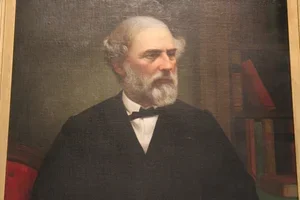
(Robert E. Lee | Source: W&L Spectator)
The year 1965 holds an especial significance for this University, a significance apart from the importance of this Commencement exercise. One hundred years ago this month the Trustees of Washington College met to review the status of the college.
The outlook was bleak. The buildings had been spared destruction but they were in dilapidated condition; most of their furnishings and equipment hat been destroyed or looted. The financial condition of the College was desperate. Much of the small endowment had been lost through investment in Confederate bonds while another portion had not drawing interest payments for several years. The salaries of the professors who remained were far in arrears.
Nevertheless the Trustees who gathered here on June 21, 1865, considered their problem with courage and faith. They determined that the College should reopen in September and they appointed committees to seek financial support and resolve other difficulties. A meeting for early August was set to undertake the election of a new president.
You know of the bold decision to invite General Robert E. Lee to accept the leadership of the College. Accounts of that meeting on August 2 suggest that the Trustees were stunned with the temerity of their action. But once the general had been nominated, no other suggestion could generate enthusiasm, and the vote on Lee was unanimous. His appointment has touched the life of every student who has come here in the century that has elapsed. On occasion I know that you become surfeited with the story of Lee’s experience at Washington College, but it is a story that hears retelling because no other institution has been so affected by the influence of one great man. Sometimes students, and others, suggest that Washington and Lee is bound too closely to the past—that this institution is inhibited by tradition and that the only way to real greatness is to look to the future and to forget the past. I am convinced, however, that none of us is so original in our concepts, or so infallible, that we cannot profit from a proper knowledge of our history.
Despite his defeat in war, Lee was a hero of the first order when he assumed the presidency here. He was idolized in the South, respected and admired in the North. Despite the fact, however, that he had served as superintendent of West Point, he was not considered to be an educational leader. Nor did the Trustees of Washington and Lee believe that they were going to find in Lee an academic qualified to deal with the problems of a destitute classical college. They were practical men and they apparently assumed that Lee would serve Washington College primarily in practical ways. A basic consideration was finance and reputation. His name would help in both these regards.
To Lee’s great credit, and to the great fortune of all associated with the College, he gave far more than his name. The destitution of the South and its people weighed heavily upon him. He welcomed the opportunity to serve his region and the nation in that time of great need.
The name of Lee did in fact bring about a dramatic strengthening of the College that perhaps exceeded the expectations of the Trustees. Admirers of Lee— Cyrus H. McCormick, Warren Newcomb, George Peabody, Thomas A. Scott, W. W. Corcoran, to name a few—responded to appeals for funds, students eagerly sought to enroll in the College, and editorials in Southern newspapers, as well as in some Northern ones, predicted that Washington College was destined to become one of the great American institutions of higher learning. The University’s historian, Professor Ollinger Crenshaw—to whom I am indebted for much of the substance of my remarks today—concludes one section of his study of Lee’s administrations with the appropriate words: “The Great Era had begun.”
While the Trustees and others were busily engaged in raising funds for the College, the president assumed responsibility for all the duties imposed upon a college administrator. He immediately set to work to learn everything about the college and its operation, its students, its faculty, and its alumni. It soon became apparent that the Trustees had not appointed a figure-head for the College. Here was a man with ideas of his own about administration and education and, to the surprise of some, they were sound ideas that formed a basis for an educational philosophy of hope and promise for a rebuilt South and a peaceful nation.
Under Lee’s direction and inspiration the curriculum was expanded and the faculty enlarged. There was a new emphasis on applied science and mathematics, on modern languages, and on history and literature. He introduced a system of electives that permitted students a degree of flexibility as against the formal, rigorously classical curriculum of antebellum days. Lee appreciated the importance of liberal education but he also recognized that there was, in the South especially, a great need for scientists, engineers, agriculturists, and business men. The Law School was added to the College during his administration and he presented recommendations for business courses and training of journalists. Ne degrees were added and the College took on the nature of a university. Plans were drawn for further expansion into the fields of civil and mining engineering, mechanical engineering, applied chemistry, and agriculture.
With Lee at the helm, faculty colleagues presented their dreams for the future. One professor proposed that a medical school be established. Although the proposal was tabled by the Trustees, there is evidence that they intended to give it fuller discussion. Other programs and recommendations, innovations that were many years ahead of their time, were debated and put aside or held for further review. The New York Herald at the time commented that the programs under way in Lexington were likely to jolt “old fogey schools just as General Lee did old fogey generals.”
Enrollments soared to the unprecedented number of 411 in 1868, and the faculty had quadrupled. All the while, Lee was bringing to bear on the institution and its students the great influence of his personality and the code which patterned his life. His own attitude toward personal honesty, courtesy, gentlemanly conduct and dress, were adopted by most of the students and subsequently passed on from one generation to another.
Then, in 1869, the president’s health began to fail, and in October, 1870, he died. With his death a large measure of the impetus he gave to the College ended. Some of his and his associates’ hopes for the school were to wait thirty to fifty years for implementation, and others, some of which were quite sound, have never been fulfilled. The kind of Washington College that Lee helped fashion and plan was a far different school from the Washington and Lee we know today. One cannot help but experience a sense of regret as he reads about this noble effort that was to fall short of complete fulfillment. Whether or not Lee’s leadership would have been sufficient to sustain the College during the difficult years of Reconstruction is impossible to answer. Alternatives to history cannot be determined. We can be sure, I believe, that many of the problems of the school and of the South would have been less had he been able to fulfill his hopes.
If we seek sure guidelines or solutions to the current problems facing higher education and the University today, we do not find clear answers, but there are remarkable parallels to the days of Lee. What we do find in Lee and in his administration is inspiration. The problems of his time were different, but his purposes and objectives were similar. We can profit from the study of the manner in which he addressed his challenges. We can marvel at the courage with which he faced a far more uncertain and discouraging future than we face today. I say this in spite of the current turmoil of our world. We can see how his character and ideals inspired his colleagues, his students, and his nation; and a century later we can feel his influence at every turn.