
The Rededication of the Lee Chapel (1963)
[The following is an excerpt from the 1963 Alumni Magazine on the rededication ceremony of Lee Chapel under President Fred C. Cole. For more info, please visit W&L Special Collection.]
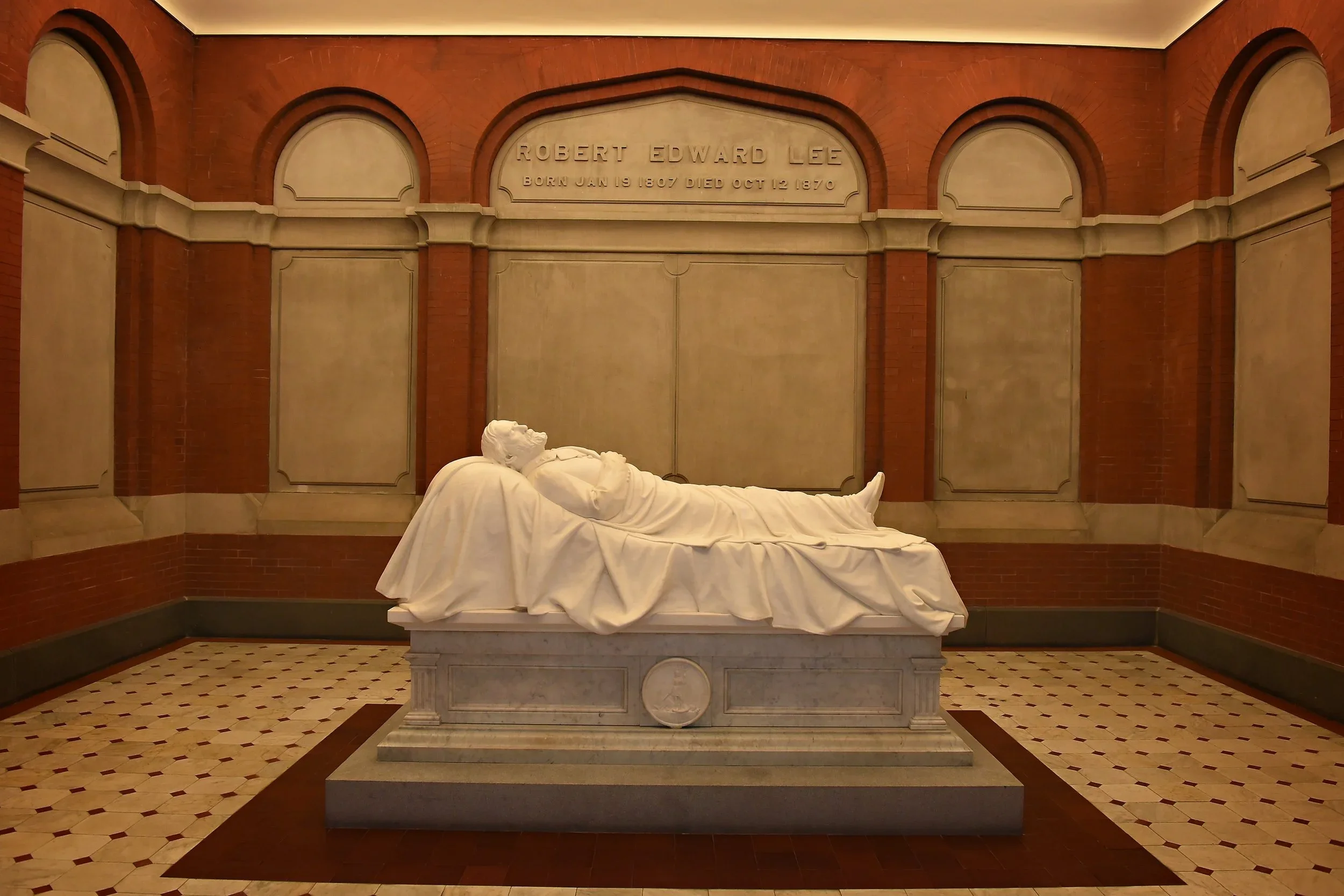
(Lee Chapel recumbent statute | Source: W&L Spectator)
Washington and Lee University rededicated its historic Lee Chapel in a simple but impressive ceremony in the Chapel’s auditorium on October 11th.
The simplicity of the formalities was in keeping with that of the original dedication of the modest brick and limestone structure that Robert E. Lee had built to serve the spiritual needs of the students of Washington College. After commencement exercises there in 1868, Lee reported to the college’s Trustees that the Chapel, “dedicated to the services of Almighty God, is a pleasing as well as useful addition to the College buildings.”
While the Chapel is no longer the scene of regular religious services, as it was in Lee’s time, the rededication acknowledged the Chapel’s symbolism of the profound Christian influence upon the life of the great soldier and educator.
The six hundred persons who witnessed the midafternoon ceremony heard brief remarks from Robert E. Lee IV, of San Francisco, who represented the Lee descendants; from Benson Ford, president of the Ford Motor Company Fund, from whose resources came the gift of $370,000 which made possible the fourteen-month restoration project; and from Washington and Lee’s President Fred C. Cole.
Each speaker emphasized the appropriateness of the Chapel as a lasting monument to Lee’s memory, not so much the memory of a military commander but of an enlightened educator, a man whose life was patterned on principles of duty, truth, and integrity.
Robert E. Lee IV, great-grandson of the general and a 1949 alumnus of the University, spoke first, describing his sentiments of the occasion: “It is a feeling of great pride, an awareness of a very strong personal link with our nation’s great past and with one of the notable figures of history. The feeling is not one that I permit myself to savor very often, and indeed, it is more precious because of the infrequency with which it comes. But this sensation of pride—and humility—is inescapable for me in these surroundings.”
Mr. Ford declared that he and the others present were rededicating “a memorial to greatness.”
“This Chapel,” he said, “holds deep meaning and stirring memories for the people of the South. But it is a shrine which belongs to a nation, for the man whose memory this structure honors belongs to all America. It is unfortunate that in spite of his fame, Robert E. Lee, the man, is still unknown to many Americas. It is not that his fame has been bounded by geography or sectionalism. It is rather that too many know him only as the gallant leader of a vanquished army. There are many, born in the shadow of his greatness, who still do not know of the traits that made him a giant among men.
Lee, the General, is already enshrined in history. Today, by this rededication, we also honor Lee the man of God, Lee the molder of young minds, Lee the healer of raw wound. Today, our rededication of this shrine reflects the lengthening shadow cast by a great man across almost a century.”
In his response to the remarks of Mr. Lee and Mr. Ford, President Cole reviewed briefly the years spent by Robert E. Lee as president of Washington College and of the continuing influence exerted upon the University by Lee’s foresight as an educator.
“Yet, if one were challenged to determine the area of Lee’s greatest influence upon this University,” President Cole said, “the answer would not be concerned with the academic curriculum, or the broad geographic origins of the student population, or similar tangible evidences of Lee’s presence here. His great contribution to this University affects not so much young men’s intellect and learning as it does their hearts, their character, their attitude toward their fellowmen.”
President Cole said, “the climate of student life” established in Lee’s administration has developed into traditions “passed from one student generation to the next and guarded jealously by each.”
“No Washington and Lee student since Lee’s time has graduated without having been personally involved in the preservation of these traditions,” said the president, “and I believe no student has graduated who is not the better man for having lived in a company of men so guided by principles of honor, integrity, and gentlemanly regard for the rights of others.”
In expressing his gratitude to the Ford Motor Company Fund for making the restoration a reality, President Cole said the University, through the Chapel and the Lee Museum there, will seek to emphasize the “enduring, universal truths” that governed Lee’s life. “We shall suggest,” he continued, “that these lofty Christian principles and personal guidelines are as timely and as important for purposeful living today as they were when Lee lived.
“Thus, in rededication of the Lee Chapel today, we not only reaffirm its heritage as a place of worship, but we encompass in its purpose a fitting tribute to the memory of a great Christian and his influence upon this University and his nation,” President Cole said…
If General Lee found the Chapel “pleasing and useful” in 1868, those who were present for the rededication and the many thousands of others who have visited the restored Chapel at other times have found it beautiful and inspiring. The charm and dignity of the auditorium gain subtle emphasis from the soft lighting and gentle colors of wall, carpet, and woodwork. In the museum, the Lee memorabilia are presented in a well-lit, uncluttered arrangement of new meaningfulness to visitors.
Perhaps the most pleasantly surprising feature of the restored Chapel is the beauty of the tonal resonance of the Erben pipe organ, also restored to original excellence. Before the rededication, Professor James G. Leyburn played an organ prelude, and at the ceremony’s conclusion he accompanied the University’s seventy-voice Glee Club in an anthem and “College Friendships.”
It was a beautiful and moving climax to what President Cole called “one of the most significant events to take place at Washington and Lee University in many years.”