
When MockCon Made Its Mark
W&L students turned to John W. Davis amid a bitter political deadlock in 1924 — and anticipated one of the most extraordinary national conventions in American history.
By Garland S. Tucker III, ‘69
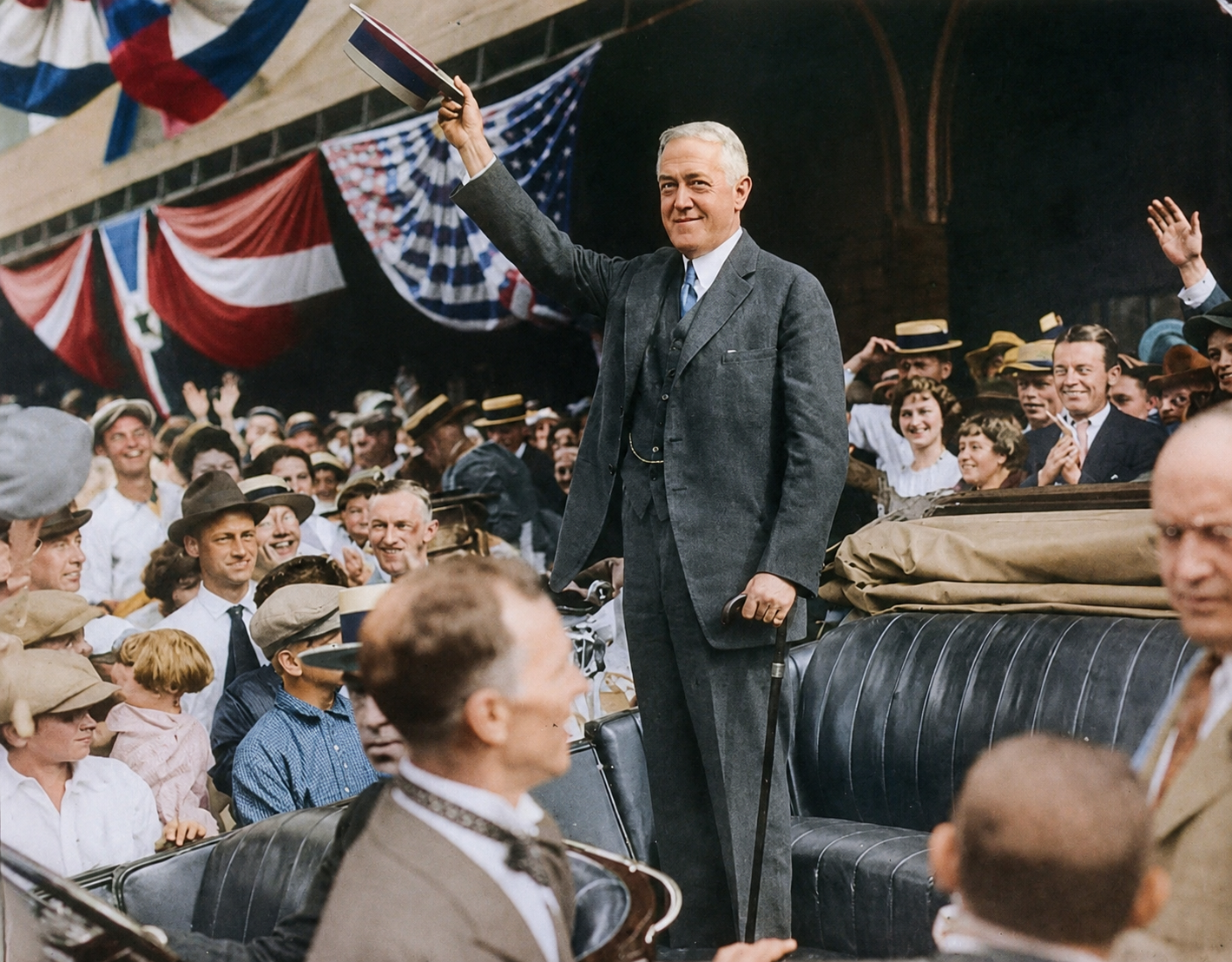
(John Davis campaigning in 1924 | WV Regional History Collection, colorized by The Redoubt using artificial intelligence)
Washington and Lee University has many illustrious traditions, certainly among which is the quadrennial mock convention, commonly known as MockCon. Inaugurated in 1908, this student-run exercise in civic involvement has long been recognized as the most accurate collegiate predictor of American political conventions.
Over MockCon’s long history, no convention was more remarkable than that of 1924. That year, W&L students confronted a deeply divided Democratic Party, endured ballot after ballot of deadlock, and finally turned to John W. Davis, former congressman, Solicitor General of the United States, ambassador to Great Britain and a two-time W&L alum (1892, ‘95L). Two months after W&L selected Davis, the Democratic Party would do the same.
Accuracy, rather than student political preference, has always been the object of MockCon. Students organize themselves into state delegations and research actual party sentiment in an effort to determine how each state is likely to vote. The result is a combination of serious political research and collegiate pageantry that has long attracted national attention.
In 1964, Time magazine described W&L’s convention as the “biggest and boomingest” of the collegiate mock conventions. Four years earlier, former President Harry S. Truman, serving as keynote speaker, offered perhaps the better tribute: “This is a real convention, and I ought to know because I've been looking at them since 1912.”
It was the 1924 convention, however, that helped establish that reputation. As a Virginia reporter observed, “It was not lacking in a single detail when compared to the real convention.”
The Republicans and President Calvin Coolidge were the incumbents, so the 1924 MockCon would be a Democratic convention. While there were no popular state primaries in those days and polling was nonexistent, it was widely understood by early 1924 that the Democratic Party was deeply divided. Prohibition, immigration, and the KKK were the hot-button social issues, and New York Governor Al Smith and former Treasury Secretary William Gibbs McAdoo were the leading candidates.
The W&L fireworks commenced with a bitter platform fight over Prohibition. Rousing speeches from the wets and drys followed. Toward the end of the speeches, a student rushed to the podium to read an urgent telegram from the Plumbers’ Union of Bangor, Maine, urging the convention “to take action toward modification of the Bone Dry Law.” It was not reported exactly why this message was offered, but the input was apparently not decisive, as the convention narrowly passed — no doubt against the students’ own better judgment — a strong Prohibition platform. As the wet forces protested, the student chairman, Randolph “Booze” Whittle, declared the issue settled and the platform ratified.
Next the students turned their attention to the central business of nominating a candidate, which was to prove amazingly prophetic. The MockCon endured twenty-two ballots during which McAdoo and Smith waxed and waned, while the various favorite-son candidates refused to release their delegates. MockCon was operating under the same two-thirds majority rule as the Democratic Party, and it became apparent that deadlock had set in.
At the conclusion of the twenty-second ballot, the convention chairman made an impassioned plea for party unity, which was followed by the mysterious withdrawal from the convention of the Texas, Ohio, and Connecticut delegations. The convention was then thrown into an uproar as rumors circulated of a “back room deal.”
After struggling to regain order and securing the return of the three missing delegations, the chairman began the twenty-third ballot. These three delegations threw their support to one of the favorite-son candidates, John W. Davis. There then followed a mad stampede to Davis, and he secured the nomination. After much hoopla, the students adjourned for a raucous post-convention celebration — presumably not in conformity with their dry platform.
Barely two months later, an astonishingly similar scene was enacted in New York’s Madison Square Garden. A bitter platform fight resulted in fistfights, the burning of a KKK cross, and mass floor demonstrations. Once again, Smith and McAdoo deadlocked. The balloting for a presidential nominee went on for an unprecedented 103 ballots before the Democrats staggered to a compromise in nominating John W. Davis. Mock Con was now solidly established as the most prescient collegiate mock convention in the country.
Perhaps a lesson in this episode is to recognize some apparent wisdom in “smoke filled, back room deals.” In the absence of primary elections, party leaders had the discretion to exercise their best judgment in times of deadlock and to seek compromise in the face of deep division.
Walter Lippmann, the preeminent political columnist of the day, saw Davis as almost the antithesis of the convention that selected him. “Davis’ nomination was the result of confidence in his character,” he wrote. A “disorderly convention” had selected “a man with a deep sense of order”; a convention “boiling with passion” had chosen “a man of serene temper.” Order, character, judgment, and temperance were qualities befitting one of Washington and Lee’s finest sons — and ones his alma mater might still hope to cultivate in its graduates today.
What makes the episode remarkable for W&L is that its students, studying those same political forces from Lexington, reached the same judgment first. The 1924 MockCon was more than collegiate political theater. Its students had studied a fractured national party closely enough to anticipate the solution that party would ultimately reach after one of the most bitterly contested conventions in American history. In doing so, they helped establish a tradition of political research, participation, and prediction that remains distinctive to Washington and Lee more than a century later.
W&L can be justifiably proud of its MockCon and its favorite son, John W. Davis.
Garland S. Tucker III, B.S. (1969), Washington and Lee University; retired Chairman/CEO Triangle Capital Corporation; author of Conservative Heroes: Fourteen Leaders Who Shaped America- Jefferson to Reagan (ISI Books) and The High Tide of American Conservatism: Davis, Coolidge and the 1924 Election (Emerald Books). He has served on the Board of Directors of The Generals Redoubt since 2025.