
A Sad Divorce: The Separation of History from Mission
May 5, 2026
By Garland S. Tucker III, ‘69
By removing history from campus life and placing it under institutional control, Washington and Lee loses the very character that once defined its education.
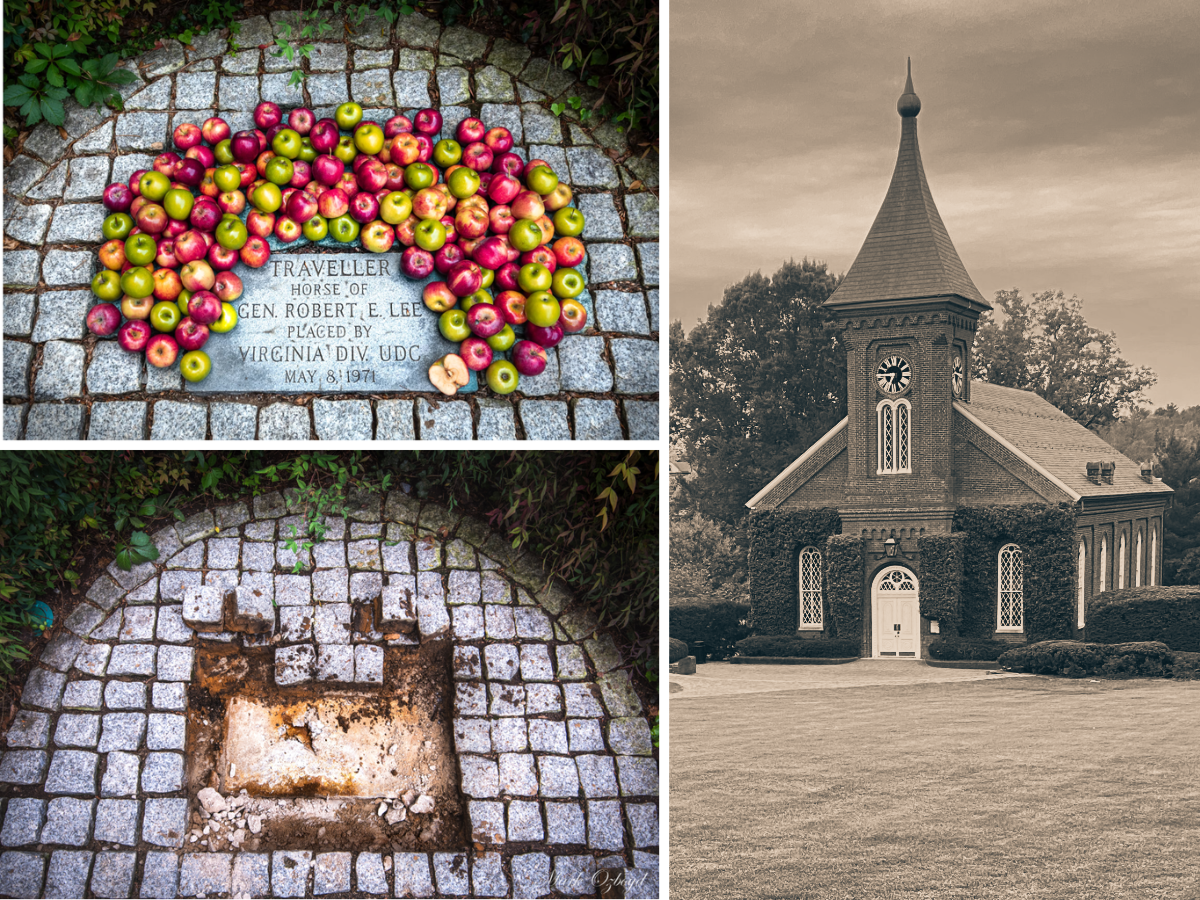
(The final photo of Traveller’s original headstone, removed by the university in July 2023. | The W&L Spectator, photo by Mark Ozboyd, ‘23)
The idea of an Institutional History Museum at Washington & Lee University surfaced in 2018 and was included in both the Strategic Plan and the Campus Master Plan. This was fallout from the 2017 Charlottesville protests and the ensuing dash of much of academia into historical revisionism. Subsequently, the university has appointed a full-time Director of the Institutional History Museum and announced funding for the museum.
These developments raise consequential questions. Why does W&L need a Museum of Institutional History? Why a Director of Institutional History? There is a great deal of history — both in the United States and worldwide — concerning the development and use of museums for the furtherance of political, social, and economic agendas. Controversy often surrounds the message museums communicate. The Director of Institutional History will presumably be responsible for interpreting and presenting the university’s history to the public. In addition to asking why the university needs a museum and a director, there is also the question: what will be the message?
For generations, students were attracted to this university by its rich history and — until recently — nurtured during their tenure by the opportunity to live and learn among numerous reminders of that history. In a Payne Hall classroom, they would sit under a plaque commemorating the inauguration of Robert E. Lee as college president. At one end of the Colonnade stood Lee-Jackson House, marking the ties to former residents “Stonewall” Jackson and Robert E. Lee. The daily walk to the Hill passed within a few feet of the marker indicating the final home of Lee’s horse, Traveller. Along the Colonnade and in Robinson Hall, they were reminded of the munificence of “Jockey” John Robinson. University events were regularly held in Lee Chapel under the Peale portrait of Washington and the Pine portrait of Lee, where plaques commemorated the contributions of alumni and benefactors, with the Valentine statue of the Recumbent Lee as backdrop. A major academic holiday was Founders’ Day, honoring the namesakes and founders. Over the last decade, the administration has systematically removed every one of these memorials and traditions from the daily life of the campus.
What has been removed is not incidental. W&L is itself a historic site. With Lee Chapel and the Washington and Lee University Historic District designated as National Historic Landmarks (in 1961 and 1973, respectively), the campus is not merely a setting for education but a preserved historical landscape, a living memorial to the university’s forebears.
In such a setting, it was difficult not to feel the daily presence of the university’s founders. There was no isolated museum to segregate the historical from the present. There was no Director of Institutional History to prescribe interpretation. Instead, the significance of the school — and the character of its namesakes and traditions — was absorbed naturally by osmosis. A distinctive mark of the Washington and Lee education was the lasting impact of these influences on generations of alumni and educators.
With the removal of portraits and plaques, the walling off of the Lee statue, the abandonment of Founders’ Day, and the de-naming of Lee Chapel, Robinson Hall, and Lee-Jackson House, an effort to divorce the present-day university from its past has become painfully obvious. Plans to erect an Institutional History Museum under the direction of a newly appointed Director are the next tangible steps in this effort to redefine how history is encountered on campus.
Taken together, these actions reflect a calculated shift in how the university administration understands itself. As the Board of Trustees asserted in 2023, “Washington and Lee University is an educational institution whose campus is neither a museum nor an appropriate repository for Confederate artifacts.”
But for generations, the campus has been precisely that — not a museum in the conventional sense, but a living historical environment in which education and memory were seamlessly integrated. Now, the university is choosing to separate them.
There will undoubtedly be conflict over the tenor, tone, and interpretation of the official institutional narrative. But the battle for the soul of the university will already have been lost if these historical signposts remain separated from daily campus life and confined to a sterile museum under the watchful eye of an institutional apparatchik. Such a separation will, in turn, diminish both the relevance of its history and the uniqueness of its education.
Garland S. Tucker III, BS (1969), magna cum laude, Phi Beta Kappa, Washington and Lee University; MBA (1972) Harvard Business School; retired Chairman/CEO Triangle Capital Corporation, author of Conservative Heroes: Fourteen Leaders Who Shaped America- Jefferson to Reagan (ISI Books) and The High Tide of American Conservatism: Davis, Coolidge and the 1924 Election (Emerald Books). Garland serves on the Board of Directors of The Generals Redoubt.