
What Yale Understood — And What Washington and Lee Refuses to Confront
April 30, 2026
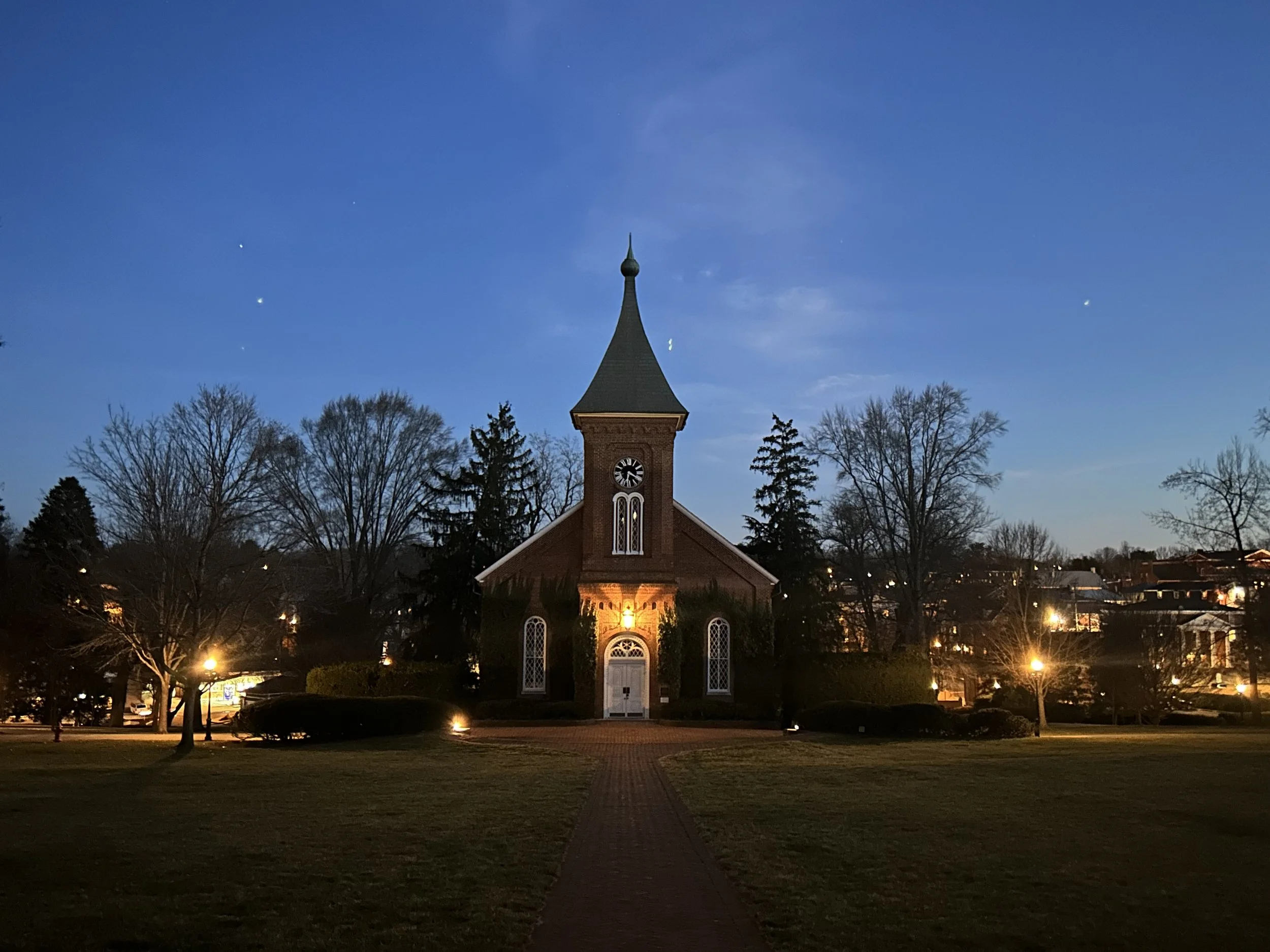
(Lee Chapel at night, 2023. | The Generals Redoubt)
Washington and Lee University’s search for its next president should begin with clarity. Instead, it began with a portrait.
The Presidential Profile released to the community is polished and comprehensive. It describes a university of distinction, momentum, and cohesion. It invokes broad community input and presents an institution well-positioned for its next chapter. What it does not do — at least not with any real precision — is identify the problems the next president is being asked to solve.
That omission matters. A university does not choose the right leader by presenting an idealized version of itself. It does so by confronting its realities.
Yale University recently offered a starkly different model. Its Report of the Committee on Trust in Higher Education (April 2026) begins from the premise that institutions must examine themselves honestly if they expect to retain legitimacy. It states plainly that universities must “be willing to admit where we have been wrong,” and warns that a tendency to be “self-regarding, insular, and unreceptive to legitimate criticism does not engender public trust.”
That is the language of institutional responsibility.
Washington and Lee’s Presidential Profile operates on a different, weaker assumption. It signals challenges without naming them. It gestures toward tensions without exploring them. It presents the institution as coherent and confident at a moment when serious questions — about academic standards, intellectual climate, historical legacy, and institutional governance — are very much alive. Indeed, these problems were the genesis of TGR’s formation seven years ago.
Even the university itself has acknowledged some of these problems in other contexts. Grade inflation has risen to the point that a formal task force has been convened to examine it. Concerns about intellectual pluralism have led to initiatives like the “Liberating Ideas” cohort. Free speech rankings have sharply declined to a D-grade (apparently, the one metric grade inflation hasn’t reached!). Students have publicly raised concerns about the predictability and transparency of financial aid. These are not marginal issues. They go to the core of what the university is and how it is perceived.
And yet they are absent from the document meant to define the priorities of the next president.
That absence is not simply a matter of tone. It reflects a deeper problem with how the search process has been structured and presented to the community.
From the outset, the university emphasized participation. It distributed a comprehensive community survey asking respondents to identify priorities ranging from diversity and access to academic excellence, campus culture, and the Honor System. It invited alumni, students, faculty, staff, and others to define what mattered most and what the next president should prioritize.
The message was clear: the community would help shape the outcome.
But when the committee published the Presidential Profile, that input all but disappeared. The report did not publish survey results. It did not summarize themes. It did not include an appendix documenting the range of views expressed. The committee called the process inclusive, but never showed its work.
This is the central flaw. Incorporation without transparency is indistinguishable from omission.
In a meeting with The Generals Redoubt on April 13, the search committee indicated that survey results would not be released in raw form. Why not? There should be some clear account of what the community said and how those perspectives shaped the final document. Without that, participation becomes a rhetorical gesture — checking boxes rather than informing outcomes.
The timeline only sharpens this concern. The Generals Redoubt met with the committee on Monday evening of Finals Week. The profile was distributed to the community on Thursday morning. Even allowing for earlier drafts, that sequence leaves little room for meaningful incorporation of late-stage input. How can the community trust that its voice made a difference?
Yale’s report makes the contrast unmistakable. Its committee spent a year gathering input from students, faculty, alumni, journalists, critics, and public officials. It explicitly acknowledges that many of these voices were “unsparing.” It admits that even the committee itself faced mistrust and that this was part of the problem it was studying. The report also includes an appendix describing its consultations and methods.
Yale did not simply ask for input. It documented it, exposed it, and allowed community feedback to shape a candid diagnosis of institutional challenges.
Washington and Lee’s Presidential Profile, on the other hand, reads less like a diagnosis and more like an admissions brochure. That may attract candidates, but it misses the point. The presidential search should align leadership with institutional need — and this profile does not clearly define those needs.
The irony is that Washington and Lee is not unaware of its challenges. The existence of committees, initiatives, and internal conversations makes that clear. The question is not whether the university recognizes these issues. It is whether it is willing to articulate them openly to itself, to its community, and to those it seeks to lead it.
Yale’s report offers a useful principle here: trust is maintained not by projecting confidence, but by demonstrating accountability. Institutions lose credibility when they cannot explain themselves, when their processes are opaque, and when their self-descriptions appear overly controlled.
Washington and Lee does not need to replicate Yale’s report in every detail. But it should adopt its core discipline: diagnose first, search later.
The university can still publish a clear summary of survey results and the major themes that emerged, including areas of disagreement. It can issue a supplemental document identifying the most significant challenges facing the institution with specificity and candor. It can engage alumni and external voices in a more transparent and documented way. And it can ensure that the criteria for selecting the next president are explicitly tied to those challenges.
None of this would undermine the institution or the search process. These steps would strengthen both and demonstrate that Washington and Lee is committed not just to presenting the university well, but to confronting itself honestly.
There is a precedent for this kind of candor in the university’s own history.
In 1865, when the trustees of Washington College invited Robert E. Lee to serve as president, they did not present him with a polished portrait. They described an institution that was financially crippled and physically damaged. The war had depleted their ranks, both student and faculty. There was no attempt to soften this reality.
Lee responded in kind. “Fully impressed with the responsibilities of the office,” Lee wrote, “I have feared that I should be unable to discharge its duties to the satisfaction of the Trustees or to the benefit of the country.”
He raised concerns about his health and about the potential impact of his reputation on the college. He did not present himself as an obvious or ideal choice. He presented himself honestly, and left the decision to the trustees: “Should you … think that my services in the position tendered me by the Board will be advantageous to the College and country, I will yield to your judgment and accept it. Otherwise I must most respectfully decline the office.”
That exchange — a frank assessment of the institution and a candid evaluation of the candidate — produced the most consequential presidency in the university’s history.
Thankfully, our institution faces far stronger circumstances today than it did in the aftermath of the Civil War. But the principle remains the same. A university that seeks the right leader must first be willing to describe itself as it is, not only as it wishes to be seen.
The current Presidential Profile does not fully meet that standard. It presents strengths clearly. It signals challenges indirectly. It invokes participation without making it visible. It is, in the end, a carefully constructed document that stops short of the candor this moment requires.
If Washington and Lee wants a president capable of confronting its future, it must first confront its present.
Sincerely,
Kamron M. Spivey, ‘24
Executive Director
The Generals Redoubt