
The Single Sanction is at a Crossroads
An AI honor case and shifting student attitudes suggest Washington and Lee may be losing sight of what once made its Honor System distinctive.
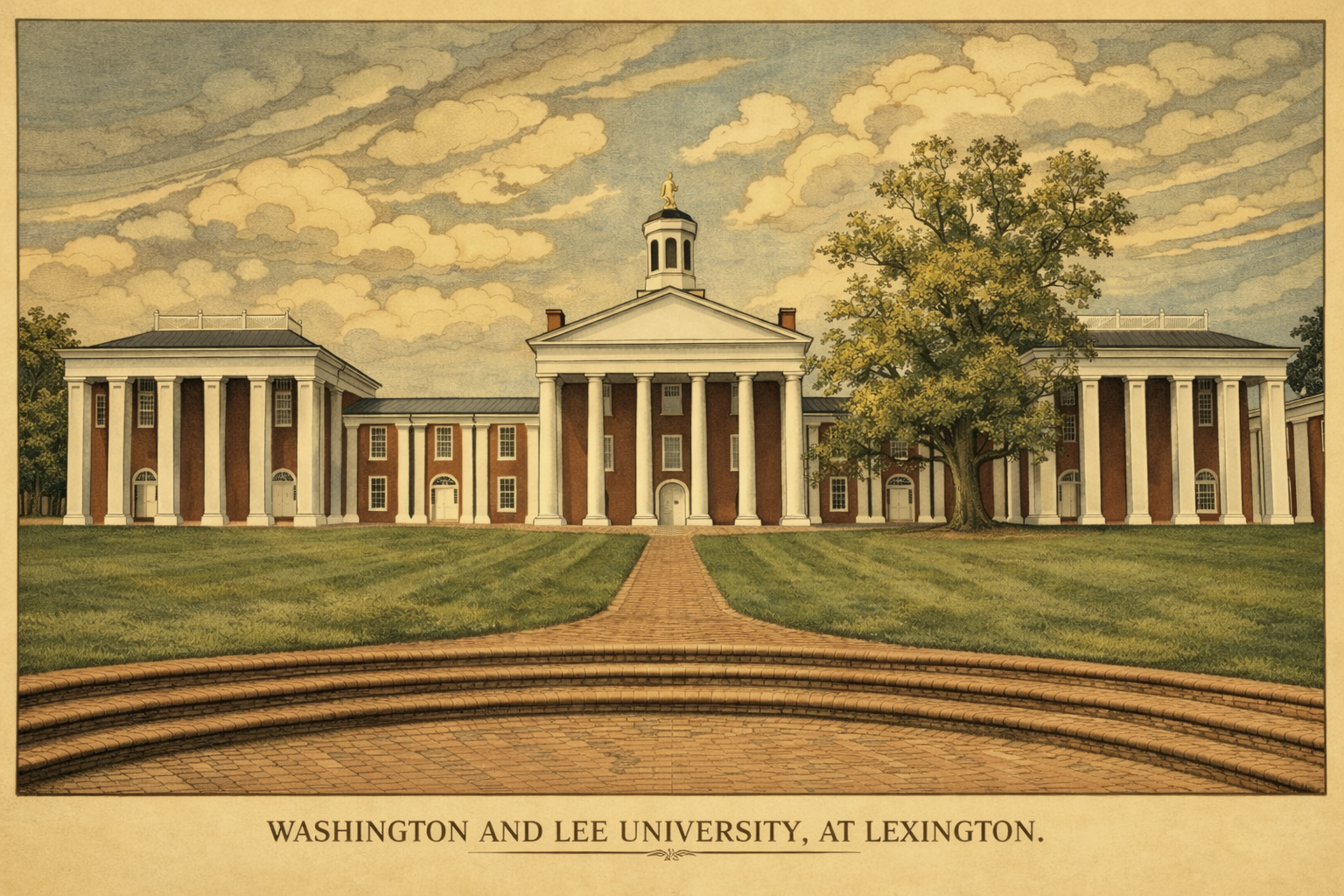
(An amber concern looms over the Washington and Lee Colonnade in this AI-generated illustration | Source: ChatGPT, The Generals Redoubt)
I recently learned of last semester’s public Honor Hearing involving the use of AI in the Law School, which has left me — like many alumni — concerned about the future of the Honor System at Washington and Lee. Evidently, there was little dispute as to the facts, and the jury determined that the student’s conduct did not violate the community’s trust. Regardless of the specifics of this case, it points to two possible conclusions about the current student body: either students are far more comfortable with cheating or shortcuts than I would like to believe, or they believe expulsion to be too severe a punishment for a one-off offense. It is likely a mix of the two, though the latter seems far more likely.
The Single Sanction is not entirely unique to W&L, but it is indisputably a defining characteristic of the Honor System, which is itself a cornerstone of the university’s identity.
Though it has always attracted criticism, the Single Sanction has traditionally enjoyed broad support among the student body, with its detractors largely confined to the margins. Occasionally, friends of an expelled student would protest it, but the issue rarely gained traction during White Book reviews. Recent polling from The Spectator, however, suggests that the current student body holds a meaningfully different view.
In its October 2025 survey of one hundred seventy-five students, 95.4% of respondents agreed that an Honor System is important for a university. That result is unsurprising. Yet while support for an Honor System was nearly unanimous, the Single Sanction itself barely cleared a majority, with just 52.1% of students surveyed viewing it favorably. 21.4% of respondents from the same poll viewed it as “highly unfavorable,” and 26% held at least a “mildly” unfavorable view of the current Honor System overall. It seems clear that today’s students, or at least a large sample of them, are out of step with prior generations.
Generational shifts in opinion are normal. But when significant changes occur over a short period, they are usually driven by a catalyst, some change in circumstances that people respond to. W&L has undergone rapid change in recent years, and it is reasonable to ask whether those changes have had a trickle-down effect on the Honor System. Culture is taught long before matriculation, and what we choose to emphasize — or ignore — has consequences. An alumnus recently told me about overhearing an admissions tour guide express near-complete ignorance of the traditions surrounding Lee House and the reason for keeping its stable doors open: so that Traveller’s ghost can come and go as he pleases.
I’m only 30, but I’ll risk sounding like an old man when I say that this would have been unthinkable when I was a prospective student. At that time, admissions tours emphasized institutional traditions early and often. Tour guides spoke glowingly about the Honor System, knew the university’s history, brought students to Lee Chapel, and were eager to discuss past honor trials that illustrated the system’s seriousness. I would not be surprised if admissions has since deprioritized these traditions in favor of appealing to students for whom they may resonate less.
After all, it was in the last decade, when I was a student, that the admissions office abruptly removed Lee Chapel from official tours. As countless Generals will attest, these tours are the earliest and best opportunity to encourage prospective students to embrace institutional values. If the Honor System’s importance is likewise de-emphasized from the outset, it should not surprise us when many students arrive without much enthusiasm for it.
Another notable finding from The Spectator poll was that 47.3% of students surveyed said the Honor System is “under-enforced,” while 25.1% said the opposite and 27.6% were neutral. No voluntary survey can perfectly reflect the views of the entire student body, but the results are instructive. Nearly half of respondents believe W&L does not enforce the Honor System enough. That raises an obvious question: whose responsibility is enforcement?
The Executive Committee (EC) can only act on cases that are reported. Responsibility therefore falls primarily on students and faculty. On the faculty side, underreporting is almost certainly widespread. Professors are not recruited with institutional traditions at the forefront of the hiring process, and fewer staff members are alumni. In a separate poll of the faculty, The Spectator found that 94.3% believed the honor system had grown weaker since they began working at the university. Only 22.2% had “highly favorable” view of the honor system, though 42.2% had at least a “mildly favorable” opinion of it. Only half, moreover, had a “mildly” or “highly” favorable view of the single sanction, including 22.7% who had a “highly” favorable view.
I am aware anecdotally of instances in which faculty pursued alternative disciplinary measures for likely honor violations rather than reporting them. While I cannot quantify this, it aligns with student perceptions of under-enforcement.
Finally, the student body itself has the power to address these issues. The White Book Committee reviews the Honor System every four years, and since I was a student, it has made at least two changes that arguably weakened it. Before I graduated, the committee removed the phrase “lie, cheat, and steal” from the White Book. More recently, it eliminated the requirement that Honor Hearing chairmen exclude prospective jurors who oppose the Single Sanction — a safeguard intended to prevent jury nullification. The most predictable effect of its removal was to allow for jury nullification, which appears to be exactly what occurred in the AI case.
My advice is simple. To the student body: reverse both changes. To the faculty and staff: hold each other — and your students — accountable. And to the admissions office: change your priorities before the culture changes further.
Sincerely,
Ben Whedon, ‘18
The Generals Redoubt