
Closing Sentences of President Wilson’s Address (1897)
[The following is an excerpt of President Wilson’s inaugural address published in the 1897 Ring-tum Phi. President Wilson highlights the importance of independent thinking and judgement in higher education. For more information, please see the full article provided by W&L Special Collections.]
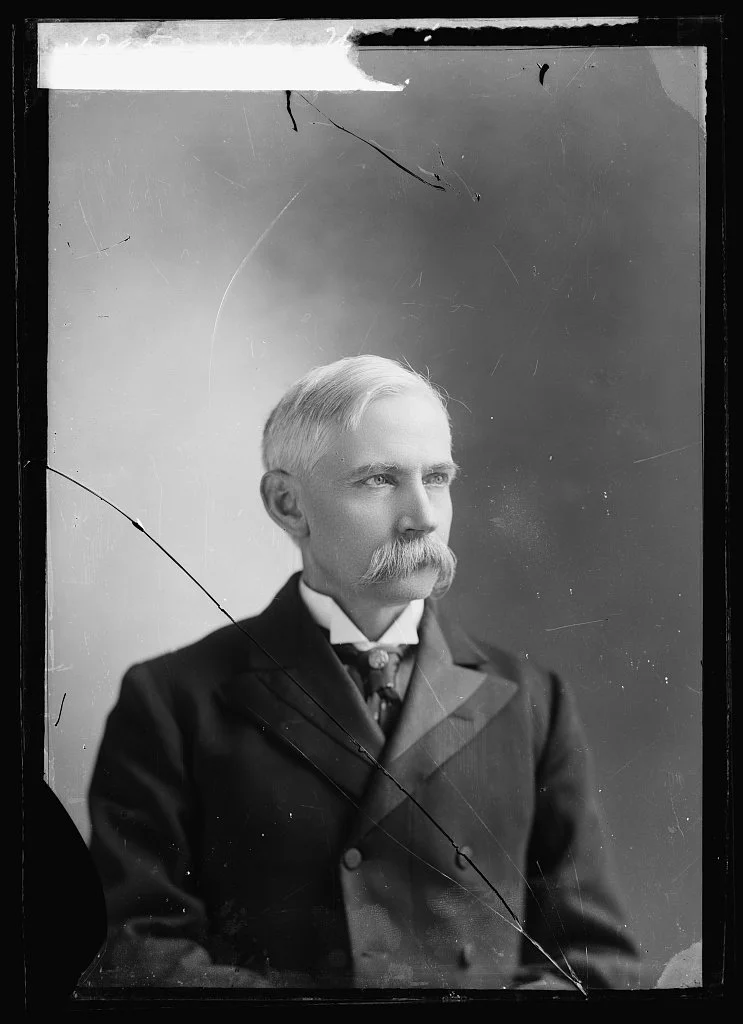
(William Lyne Wilson, c. 1894 | Source: Library of Congress)
The following are the closing sentences of the inaugural address of Hon. William L. Wilson yesterday at Washington and Lee:
If the South is to produce for her own service, if she is to contribute, as in days past, to the whole country statesmen, legislators and judges, able to maintain her influence and proper dignity as a great section of the American union, her sons must continue to give, as Mr. Blaine declares their fathers gave, “deep study to the science of government,” and if amid the harder conditions that confront them after leaving college, they are no longer able to give that study in the seclusion of their own libraries, the proper foundations for it must be laid in the schools of learning.
Let it not be understood that such studies are designed to train recruits for any partisan camp, still less to mold them to the views of any teacher. I am no disbeliever in sturdy partisanship that seeks through political organization the highest good of the country; but it is to generate and develop the desire and the power of independent, original research, to foster the habit and the ability of independent judgement; to acquaint men with the origin and historic growth of our institutions, with the fundamental principles of government, and so to enrich them with the results of human experience that they can decide on this or that policy as it may strengthen or weaken our freedom, this or that economic doctrine as it may advance or impair the general welfare; above all to make them intellligent and strong leaders, not servile and ill-informed followers of public opinion or selfish beneficiaries of popular delusions.
This is not only to advance the cause of high education but the cause of free government, by helping to retain and to prepare for the service of the country that “better mind which is said to be growing more and more alienated from the highest of all sciences and services the government of it.” For such education the examples and inspiration are all around us; nowhere more than in the past history of this commonwealth, or in the names associated with the origin and past history of this school.
We throw away the richest part of our endowment if we do not bring these examples and inspirations to the education of our young men; if we do not mold into their very stamina the patriotic principles of those fathers and those founders and those illustrious pupils of the past, and such loyalty to those principles as will not barter or surrender them to any ambition for personal advancement or to any fear of personal consequence. They need to learn that it is harder to preserve freedom in peace than it is to win freedom in war; that it is as disloyal and as shameful to falter or desert in the one struggle as in the other; and that it may require a courage as high and thoughtless of self as that which served William Campbell and his fellow students of a century age to scale the slopes of King’s Mountain.
Neither can we pass over to others, no matter how fair and honest they may be, the task of writing our own local history; of vindicating and establishing the just credit and contribution of our state and our section to the achievement of American independence, to the founding of our constitutional government, to the expansion of our territory or to the past greatness and glory of our Union. Still less can we pass over to others, however patriotic and capable they may be, any share of our own part in the task and duty and the abiding honor of governing our common country, of perpetuating its freedom, of promoting its prosperity.
Our youth must have the same educational training as the youth of other parts of the country to fit them for leadership, a leadership based upon the broadest, most enlightened and American statesmanship, and in this training Washington and Lee University is called upon to take no minor part among the schools of the South and of our beloved country.
And now, Mr. Rector, I have taken the oath which the statutes of this college require you to administer to its president elect. I have taken it with no reservations and with no illusions, but as stated in my formal letter of acceptance, with the lesson learned in the hard school of life, that no great duty can be met without great effort, patience, and singleness of purpose. These I hope to bring to the office to which the trustees have called me. I know that by this oath I take my place in a line illustrated in the past century and a half by great abilities and great virtues. To recall with discriminating praise all who have presided thus University is a task for which I am no competent. To mention some would be invidious, but there is one name which stands out on the roll of the world’s greatest men as the symbol of the highest virtue and most perfect manhood that human nature has ever attained. The inspiration of that name and the memory of his lofty character will always linger as a noble educational influence around this college, revived and perpetuated as they have been in recent years by his worthy son. No man deserving of your choice could assumed in any vain or self-sufficient spirit the headship of an institution endowed by George Washington and once administered by Robert E. Lee.