
Thousands View Lee Tomb Yearly (1930)
[The following is a 1930 article from the Lexington Gazette describing the relics found in the Lee Chapel Museum. For more information, please see the full article provided by the Virginia Chronicle.]
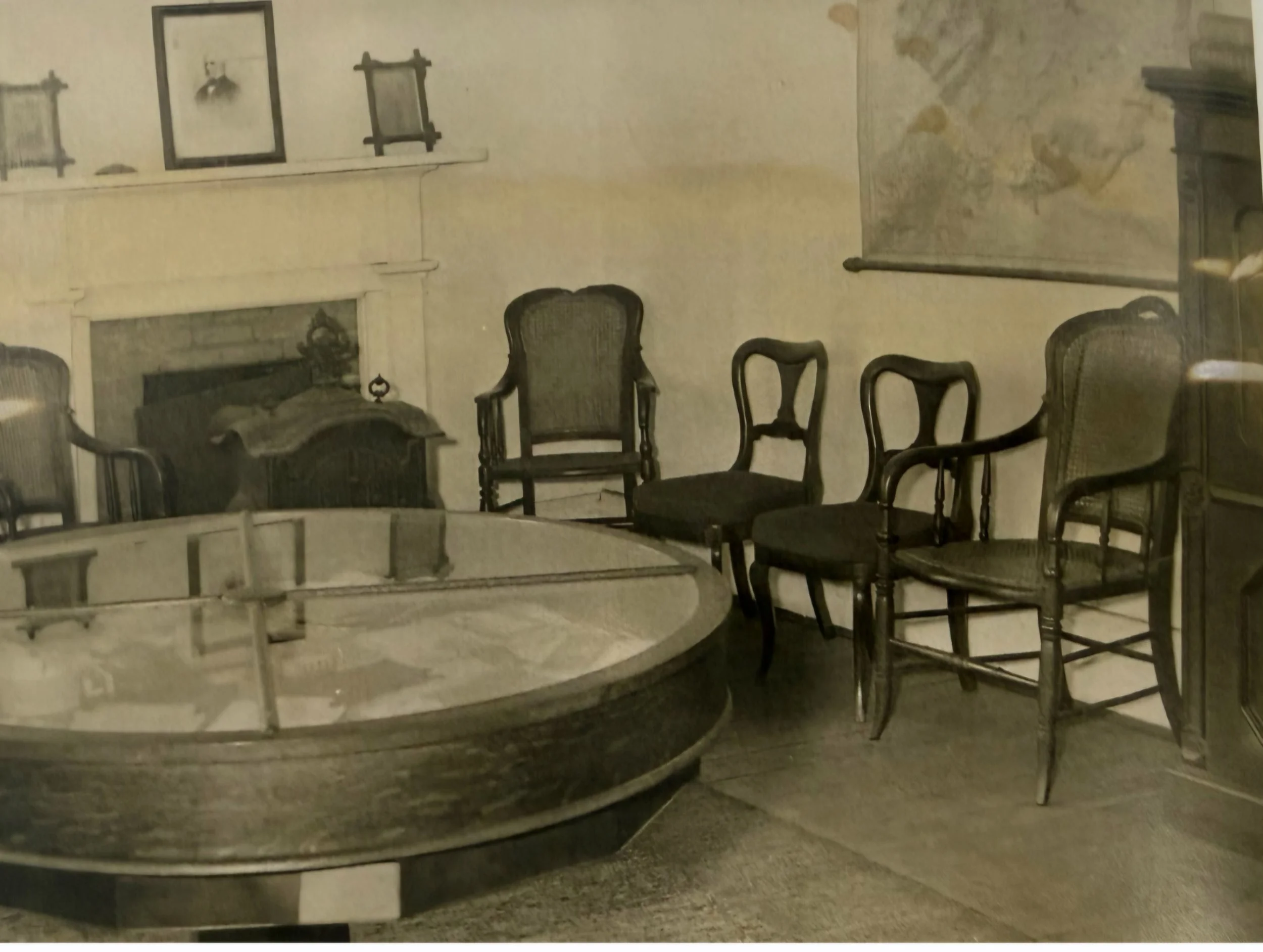
(Lee Chapel Museum | Source: W&L Special Collections)
An average of 55,000 persons a year visit this historic little southern town to see the Lee museum and chapel with their rich collection of relics connected with the early history of the United States and the Civil War. Last year the visitors represented every state in the Union and fifty-five foreign countries.
The location of the museum on the ground floor of the Lee Memorial chapel on the campus of Washington and Lee University has evolved from General Lee’s first office as president of Washington College, through the headquarters of the college Y. M. C. A., established by Lee in 1868, and the mausoleum where from 1870 to 1883 the body of General Lee lay. The chapel and museum are now internationally known.
Though this shrine was named after Lee, relics found in it are not confined solely to his immediate family. During its nearly 200 years of existence, Washington and Lee University has been closely connected with other historical periods. This southern school is the only institution of learning ever endowed by George Washington and, with the exception of West Point Military Academy, the only institution ever presided over by Robert E. Lee.
Upon entering the museum, the visitor finds for souvenir purposes biographies, Confederate notes, coins, pennants, postcards, calendars, and copies of Jefferson Davis’ bail bond with all the original signatures.
One of the three rooms occupied by this museum has for sixty years remained untouched. This was General Lee’s office. On a table in the center of the room, just as the general left them, are to be found pen, ink, pen wiper, paper cutter, a professor’s report from the school of Latin at Washington College, a letter from London, and a book of religious readings. A bookcase, writing desk, chairs, couch, and wood heater, presented from all over the country by admirers of General Lee, make up the other office furniture. On the wall hangs a map of Augusta County, General Lee served as president of the board that surveyed for this map. A waste basket beneath the table in the center of the office was given the general by an old colored woman of Lexington.
In the main room of the museum, a stone tablet on the floor marks the first burial place of General Lee. The inscription reads: “This stone marks the spot where the mortal remains of General Robert Edward Lee rested from 1870 to 1883— placed by the United Daughters of the Confederacy, 1929.”
In 1883, when the mausoleum and Valentine recumbent statue of General Lee was completed, the body was removed to the vault and placed directly beneath the statue.
About the walls of the memorial are arranged portraits of ancestors of the Lee and Washington families. A number of letters written by General Lee and returned to the university since his death, a lantern he used during the War Between the States, a campaign map, his engineering instruments, and the covering which was spread over his bier while the body lay in state in Lee Chapel in 1870 are displayed to the visitors.
In a corner of the main museum room stands a large rosewood piano inlaid with mother-of-pearl in different colors. Among these inlayings and just above the center of the keyboard is the inscription, “Robert E. Lee.” This piano was given General Lee by Stieff, the maker of the piano, and was brought to Lexington by way of canal boat.
In a glass-topped case are two locks of the general’s hair, handkerchiefs, a linen suit worn by him, his commission as lieutenant colonel in the United States army, a clock included in his equipment during the war, his razor, watch, and various small articles.
Other cases contain collections of photographs, shells, and small weapons from the battlefields of the South, Confederate bonds and notes. In two upright cases in the center of the main room are displayed letters and documents of the period from 1861 to ‘65, military correspondence, passes, muster rolls, telegrams, soldiers’ letters, paroles and newspapers printed on the back of sheets of wall paper.
This museum also contains a photostatic copy of a diploma granted George Washington in 1789 by Washington College, Maryland, in recognition of his achievements in various fields. In a frame on the wall hangs the indenture, written and signed by George Washington, in which he endows Liberty Hall Academy, now Washington and Lee University, with 10 shares of James River canal stock. This stock was given to Washington by the Virginia legislature in appreciation of his service to the state.
A clock that hund in General Lee’s kitchen in Lexington, a photograph bearing his last autograph, a brick from the building Lee surrendered in, and photographs of the house and interior of the room in which the terms of surrender were agreed upon are other articles of interest brought to the visitor’s attention.
The skeleton of Traveller, General Lee’s war horse, is mounted in a glass case in the main room. This horse was first buried near Lexington, but in 1907, was mounted as another memorial to the Confederacy.
Recently added to the collection of oil paintings in the museum are two original landscape oil paintings made by Mrs. Robert E. Lee for her son, G. W. Custis Lee, while his father was at war in Mexico. These paintings were taken from French prints. An old fiddler, seated beside the road with his dog and playing for two small children, is shown in one of the pictures. The other is that of a mother, a baby in her arms and a young girl and a dog near, seated on a cliff beside the sea.
During the last few months, a complete field “kitchenette” sent from England during the Civil War to General Lee by a British admirer, was added to the collection. This chest was seized at New York by the federal government as contraband, and, after Appomattox, turned over to the Lee family. This elaborate, silver service which lay in a federal custom house while its intended possessor ate from tin platers, strands in striking contrast to the field mess kit which Lee actually used, also among the Lee museum collection.
The latest addition to these relics is the most prized likeness of General Lee, presented the museum by Edward V. Valentine, creator of the recumbent statue of Lee. This photograph was one of four ordered by the general in 1864 and sent through the blockade to Valentine in Berlin, who modelled a statuette from them and sent it to the Southern Bazaar in Liverpool to be sold for the southern cause.