
[The following is a pamphlet pulled from the Henry Louis Smith collection in W&L Special Collections. It was written by W&L President Henry Louis Smith on Robert E. Lee’s contributions to the school. For more information, please visit W&L Special Collections.]
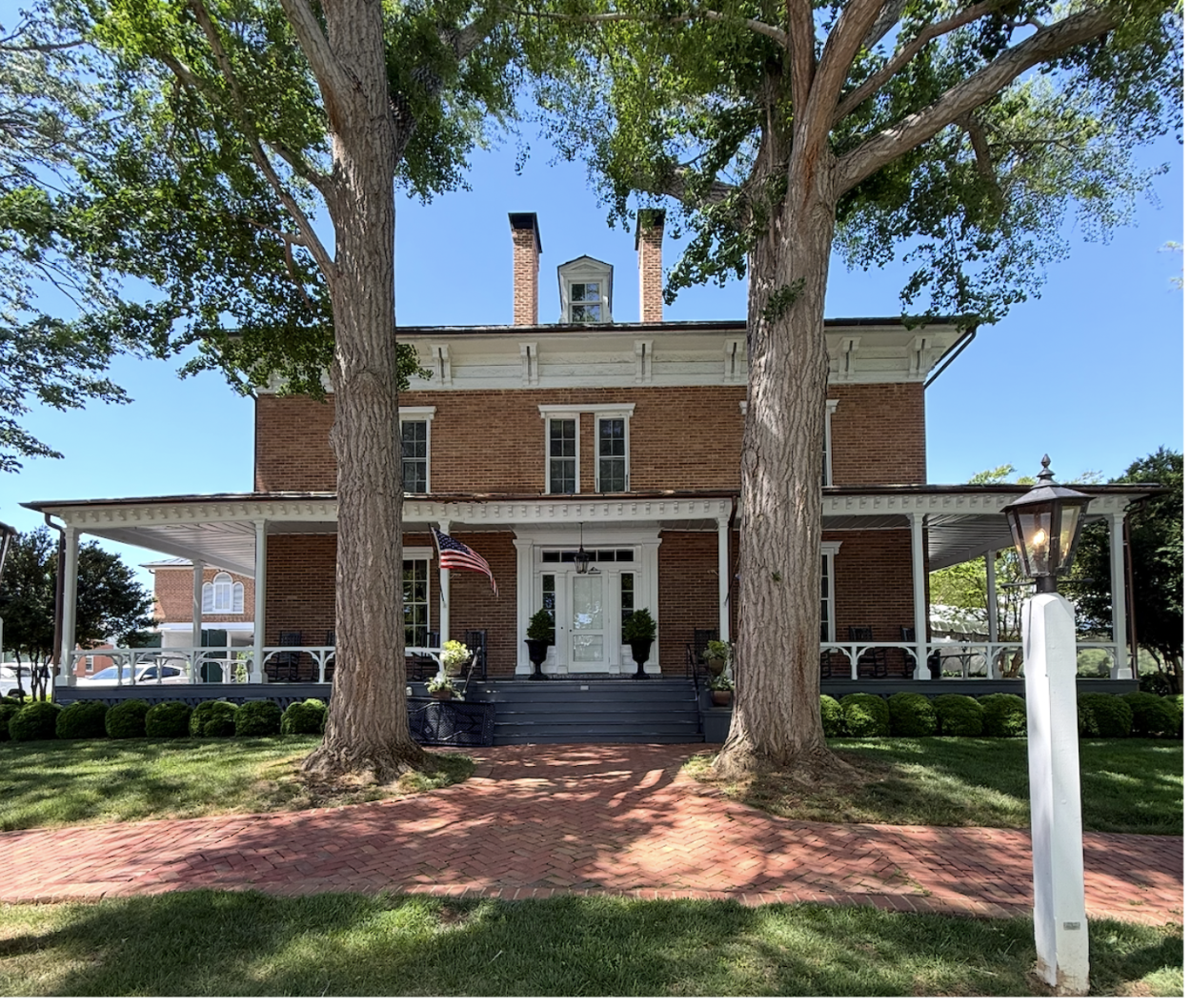
(Lee House | Source: The Spectator)
In General Lee’s matchless character were distilled and concentrated all the ideal virtues of Puritan and Cavalier combined. Our present duty and privilege is to recall to the present generation not Lee the hero of a hundred battlefields, the demigod of war, but Lee the Christian saint, Lee the ardent peace-maker between North and the South, Lee the transcendent victor over defeat, Lee the Christian Educator, whose lifework after Appomattox, when all its manifold results are finally summed up by heaven’s unerring calculus, will outshine, outweigh, and far outlast all the more spectacular glories of his military campaigns.
First, then, Lee the Christian, whose spiritual consecration, amid the irregularities and manifold temptations of a lifetime of campaigns and battlefields, was the dominant and all-consuming passion of his life.
Thrice fortunate is the South and through her the nation and the civilized world that whenever and wherever, through the long ages of the future, she turns her eyes toward the stately figure of her ideal hero, on the pinnacle of his ever-growing fame, she sees floating over his head, as the one flag of his eternal allegiance, not the stars and stripes which he so sorrowfully furled and laid aside, nor the stars and bars which disappeared forever amid the smoke of battle, but the sacred banner of the cross, that star-lit battle-flag that knows no North or South, no surrender or defeat, no Gettysburg or Appomattox, that shall yet float in universal triumph over land and sea.
In these troubled times of waning faith and restless uncertainty and perplexed bewilderment let us pray that we and our children may from his lofty life learn this uplifting lesson: that living, loving, personal faith in a living, loving, personal God is at once the source, the inspiration, and the most accurate measure of all true human greatness.
Our second picture is of Lee the Peacemaker. Amid the devilish cruelties and intolerable suffering of war, hatred of one’s enemies is not only natural to the human animal but is generally looked upon as a patriotic duty. When one’s dearest friends are falling mangled and dying at his side, when one’s loved ones are homeless and penniless, when one’s homeland is ravaged and laid waste with ruthless cruelty, it takes a Christ-like heart to forgive one’s foes. Yet from the beginning of the war to its disastrous close, and through all the horrors and injustices of the reconstruction period, General Lee was a foe without hate, a constant lover of his whole country north and south, as solicitous for the welfare and protection of the helpless non-combatants of Pennsylvania as of his own Virginia.
Not all the ruthless horrors of Butler’s armies in Louisiana, of Sherman’s in Georgia, of Hunter’s in the Valley of Virginia could tempt him to reprisal or even awaken hatred in his heart. What other leader in all history of warfare when his armies had been crushed and his land swept by fire and drenched in blood, could say of his enemies, “I have never seen the day when I did not pray for them?”
It was due to his overwhelming influence that the war ended at Appomattox and the nation was spared the endless horrors and hatreds of guerilla warfare. To his patriotic efforts and shining example, more than to those of any other leader north or south, we owe the obliteration in a single generation of sectional bitterness and the present harmony of our reunited nation.
The third majestic picture I would paint is that of Lee the Builder of a New South, the Engineer of a new Era, Lee the Educator.
When his starved and ragged handful of heroes surrendered at last to overwhelming forces, the greatest soldier of his time found himself without a profession, in the midst of a bankrupt and devastated land. Worn by toil and hardship, his wealth gone, his stately home confiscated, with a helpless family dependent upon him for support, he was at once offered wealth and a home in England, wealth and high military position in Egypt, and a huge salary as the nominal head of an honorable business enterprise at home.
Meanwhile the Rector of the Board of Trustees of Washington College, his borrowed coat and borrowed horse and borrowed money for traveling expenses typifying the desperate poverty of his war-wrecked and bankrupt institution, rode across the Blue Ridge and urged the idol of the South, on a salary of fifteen hundred dollars, not a dollar of which was yet in sight, to bury himself in a mountain village forty miles from the nearest railroad and undertake the herculean task of rebuilding the fortunes of a bankrupt college and preparing the young men of the South to solve the problems and bear the burdens of their harassed and stormy times.
On one hand was rest; rest for his worn body and for his worn mind, ease and wealth and comfort and medical care not only for himself but for those he so tenderly loved, the adoration of friends, a peaceful evening of his stormy life.
On the other were ceaseless labor and daily worries, painful and conscientious adjustments to a new and exacting sphere of duty, an unending struggle with grinding poverty and lack of equipment and resources, no possible prospect of rest, ease, wealth, or peace, till he found them all in the grave.
His decision was the sublimity of self-renunciation at the combined call of duty and of opportunity. Mounting his war-horse, Traveler, General Lee rode alone four days westward across the Blue Ridge and quietly entered upon a creative task of educational statesmanship, which, when all the results of his life’s work are finally summed up, will prove to be by far the most fruitful period of his eventful career.
Never had such a leader of men given himself to an institution of learning. One year was spent studying the institution’s historic past, its present problems, and its possible future service to a wrecked and prostrate land, whose social and industrial system had been annihilated. Then, with daring progressiveness, with consummate ability, with resistless and untiring energy, the reconstruction begins.
To the traditional undergraduate work in Latin, Greek, Mathematics, and Philosophy were added in rapid succession departments of English, Modern Languages, Applied Chemistry, and Natural Philosophy, and each year a thoroughly planned professional school was presented to the Board and formally approved and adopted by them:
In 1867 with a School of Law and Equity to furnish the new era with highly trained lawyers and legislators. In 1868 a School of Civil and Mining Engineering to rebuild the wrecked South. In 1869 a practical and theoretical School of Journalism, with fifty scholarships, to furnish the New Era with trained leaders of public opinion; and in 1870, a thoroughly planned university School of Commerce and Business Administration for the industrial and economic leadership of the new civilization. These last two were the first university schools of this type or name in America or the world.
Thus, in five years this former Superintendent of West Point worked an outstanding miracle in the history of American non-military higher education and placed Washington’s ancient college fifty years ahead of its times. Thus he transformed and developed, in five post-bellum years of poverty and wreckage, an ancient classical college into a 20th century university of practical training. Thus, he gathered students, teachers, and endowments on Washington’s educational foundation, saturated the institution with his spirit, fixed for all time its campus traditions of chivalry, courtesy, and personal honor, and then, worn out by his incessant labors, fell at his post, and bequeathed to it his matchless example, his sacred dust, and his incomparable name.
Thus like his divine Exampler, he sacrificed his mortal life that his lifework might become immortal, and taught the world the glory of self-renunciation, of whole-hearted Christian consecration, of fidelity to the heaven-sent duty of the hour at whatever cost of personal sacrifice.
Would God such a spirit, such mortal energy, such educational statesmanship, were leading our stormtossed America today!
Surely never were we in greater need of the sense of human brotherhood, of the spirit of loyal obedience to constitutional law, of the subordination of personal and national ambitions to the welfare of distressed and despairing humanity, and of the serene and unwavering faith and trust which upheld and steadied our fathers in those days of disaster and defeat.
And let us of the New South and of the New Era, intoxicated with recent war-victories and material prosperity, in this momentous period of post-war change and reconstruction, learn once for all, not from General Lee’s example alone, but from our own fathers and mothers of 1865, the supremacy of the things of the spirit over those of time and sense.
And let me, as their unworthy spokesman, reaffirm what Lee and his followers believed with all their heart, what the shades of our mighty dead still proclaim from storied urn and monumental granite, and what the Lee Legion of today is endeavoring to disseminate and perpetuate, that all true greatness, whether of individual or of national, is always and forever moral, never merely nor mainly material. Our visible possessions, our houses and lands, our railways and factories, our cannon and battleships,-- these are not the essentials of Christian civilization, but only its tools and trappings, already on their way to the scrapheap. Among them national character rises like a marble shaft amid piles of decaying rubbish.
National wealth may come and it may go. National power may wax and it may wane. The passing centuries are forever changing national customs of dress, architecture, government, and finance. But the great moral judgments of the world, moral standards, moral laws, moral ideals,-- these stand unchanged from age to age. No transient splendor of accumulated wealth and universal luxury can ever make this land of ours truly great or even truly rich. Our invisible assets must not only be accumulated but rated and utilized at their real value. Civic honor and purity, heights of national ideas, capacity for heroism and self-sacrifice, commercial honesty and domestic virtue, love of justice and sense of human brotherhood, – these cannot be measured by long lists of industrial enterprises by millions or billions of accumulated capital, or even by percentage ratios of literacy and illiteracy.
And as we plunge once more into the busy whirl of our amazing material development in this amazing age of transition and reconstruction, let us carry deeply graven on our responsive hearts this solemn and awakening truth; that the most momentous question which confronts the New South and the Nation of today is not one of manufactures or commerce or transportation, not what we buy or make or sell, not what we have nor what we will get, but what we are and what our children will become.