
Washington Doubles Down Following the Reception of King George III’s Proclamation (1776)
[Washington and the Continental Congress respond to King George III’s assertion of open rebellion by solidifying their resolution to fight and fly the new Union Flag. For further reading, please visit the National Archive. This highlight is part of our ongoing Legacies of Liberty series, where we celebrate Washington and Lee’s Revolutionary founders.]
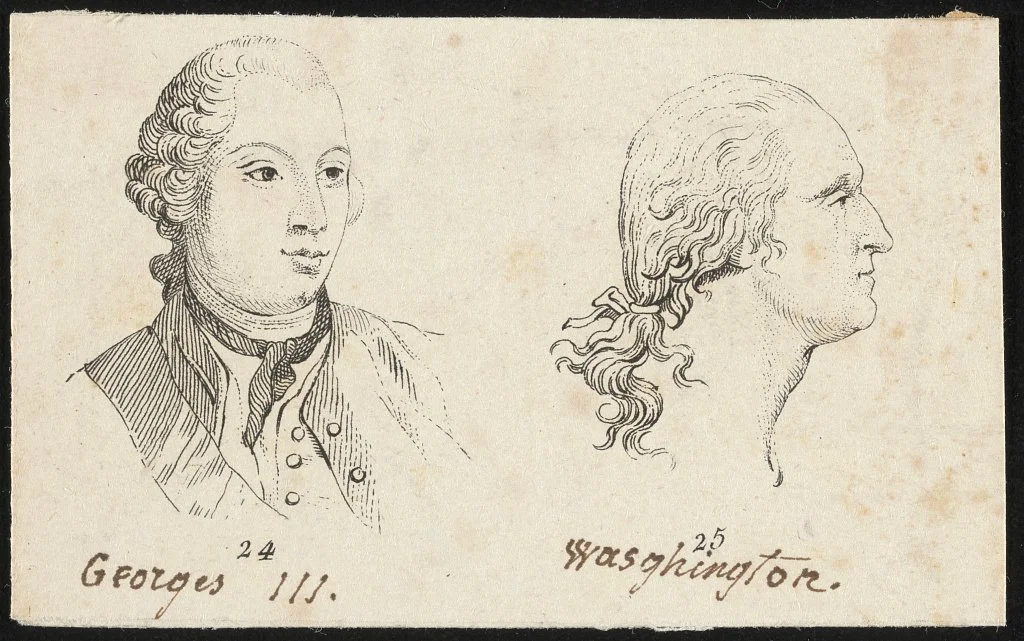
(Print of George III and Washington | SOURCE: Library of Congress)
To Lieutenant Colonel Joseph Reed
Cambridge 4th Jany 177[6]
Dear Sir,
Since my last, I have received your obliging favours of the 19th & 23d Ulto & thank you for the Articles of Intelligence therein containd; as I also do for the Buttons which accompanied the last Letter, altho I had got a set, better I think, made at Concord.
I am exceeding glad to find, that things wear a better face in Virginia than they did some time ago; but I do not think that anything less than the life, or liberty, will free the Colony from the effects, of Lord Dunmore’s Resentments and Villainies.
We are at length favourd with a sight of his Majesty’s most gracious Speech, breathing sentiments of tenderness & compassion for his deluded American Subjects. The Eccho is not yet come to hand; but we know what it must be; and as Lord North said, & we ought to have believed (& acted accordingly) we now know the ultimatum of British Justice. The Speech I send you—a volume of them was sent out by the Boston Gentry—And, farcical enough, we gave great Joy to them (the red Coats I mean) without knowing or intending it, for on that day, the day which gave being to the New Army (but before the Proclamation came to hand) we had hoisted the Union Flag in compliment to the United Colonies, but behold! It was receivd in Boston as a token of the deep Impression the Speech had made upon Us, and as a signal of Submission—so we learn by a person out of Boston last Night—by this time I presume they begin to think it strange that we have not made a formal surrender of our Lines. Admiral Shuldam is arrivd at Boston. The 55th and greatest part, if not all, the 17th Regiment, are also got in there—the rest of the 5 Regiments from Ireland were intended for Hallifax & Quebec; those for the first have arrived there, the others we know not where they are got to.
It is easier to conceive, than to describe the Situation of My Mind for sometime past, & my feelings under our present Circumstances; search the vast volumes of history through, & I much question whether a case similar to ours is to be found. To wit, to maintain a Post against the flower of the British Troops for Six Months together without—and at the end of them to have one Army disbanded and another to raise within the same distance of a Reinforced Enemy—it is too much to attempt. What may be the final Issue of the last Manouvre time only can tell. I wish this Month was well over our heads. The same desire of retiring into a Chimney Corner siez’d the Troops of New Hampshire, Rhode Island, & Massachusets (so soon as their time expired) as had Work’d upon those of Connecticut, notwithstanding many of them made a tender of their Services to continue till the Lines could be sufficiently strengthned. We are now left with a good deal less than half rais’d Regiments, and about 5000 Militia who only stand Ingaged to the middle of this Month; when, according to custom, they will depart, let the necessity of their stay be never so urgent. Thus, it is that for more than two Months past I have scarcely immerged from one difficulty before I have plunged into another—how it will end God in his great goodness will direct, I am thankful for his protection to this time. We are told that we shall soon get the Army compleated, but I have been told so many things which have never come to pass, that I distrust every thing.
I fear your Fleet has been so long in Fitting, and the destination of it so well known, that the end will be defeated, if the Vessels escape. How is the arrival of French Troops in the west Indies, & the hostile appearance there, to be reconciled with that part of the Kings Speech wherein he assures Parliament, “that, as well from the Assurances I have receivd, as from the general appearance of Affairs in Europe, I see no probability that the Measures which you may adopt will be interrupted by disputes with any foreign Power.”
I hope the Congress will not think of adjourning at so Important, & critical a Juncture as this. I wish they would keep a watchful eye to New York—from Captn Searss Acct (now here) much is to be apprehended from that Quarter. A Fleet is now fitting out at Boston consisting of 5 Transports & two Bomb Vessels under Convoy of the Scarborough & Fowey Men of War—300 some say, others more, Troops are on board, with Flat bottom’d Boats. It is whisperd, as if designedly, that they are intended for New Port, but it is generally beleiv’d that they are bound either to long Island, or Virginia. The other Transports are taking In Water & a good deal of Bisquet is Baking—some say for the Shipping to lay in Nantasket Road to be out of the way of Ice, whilst others think a more Important move is in Agitation—all however is conjecture. I heartily wish you, Mrs Reed & Family the Complts of the Season, in wch the Ladies here, & Family, join.
Be assured that I am with Sincere Affecte & Regard