
[In a letter to his brother, Washington mourns the American’s defeat at Fort Washington and complains about the issue of short enlistments and raising more troops. For further reading, please visit the Hathi Trust Digital Library to view The Writings of George Washington. This highlight is part of our ongoing Legacies of Liberty series, where we celebrate Washington and Lee’s Revolutionary founders.]
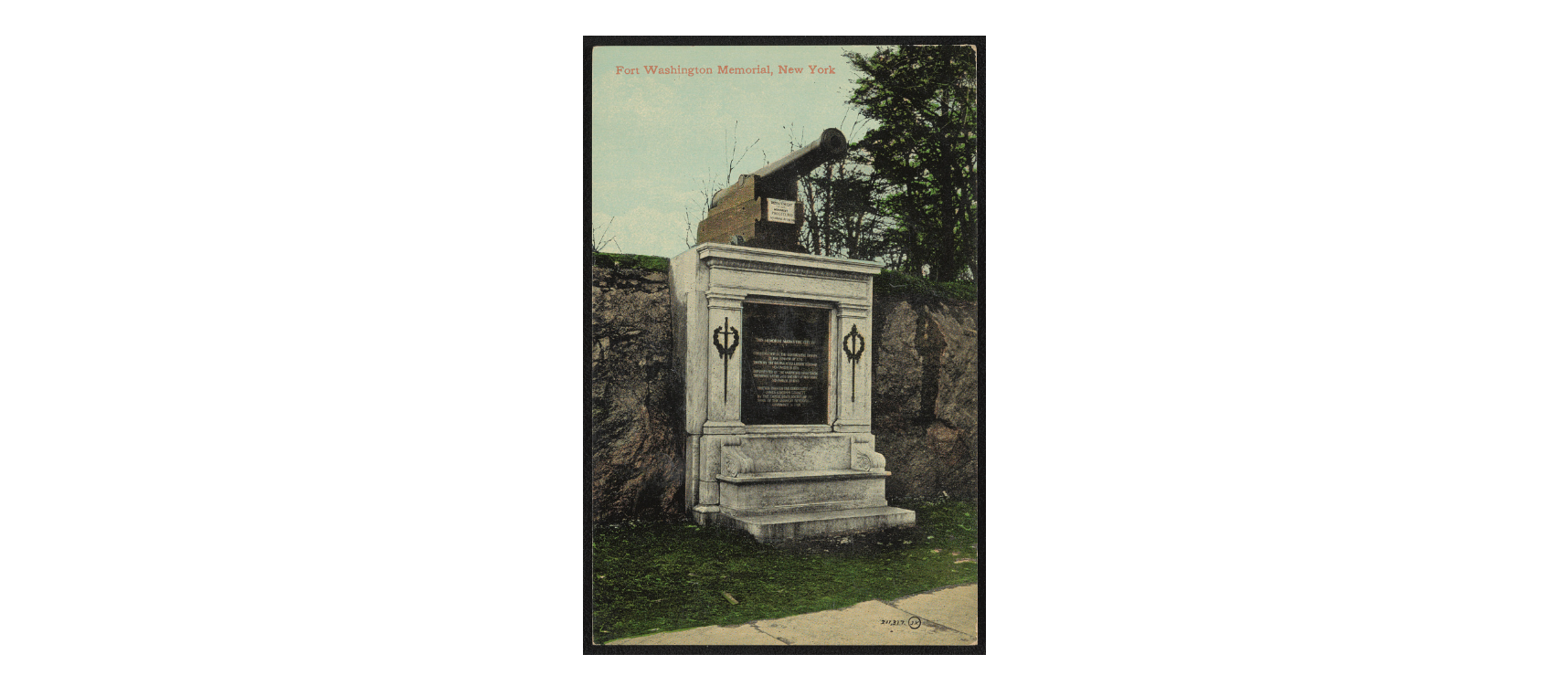
(Battle of Fort Washington Memorial | Source: Library of Congress)
To John Augustine Washington
Hackinsac, 19 November 1776
Dear Brother,
At the White Plains, the enemy advanced a second time upon us, as if they meant a general attack; but finding us ready to receive them, and upon such ground as they could not approach without loss, they filed off and returned towards New York. As it was conceived that this maneuver was made with a design to attack Fort Washington or to throw a body of troops into the Jerseys, or what might be still worse, aim a stroke at Philadelphia, I hastened over to this side with about five thousand men by a circuitous march of about sixty-five miles, which we were obliged to take, on account of the shipping that opposed the passage at all the lower ferries. But I did not arrive in time to take measures to save Fort Washington, though I got here myself a day or two before it surrendered, which happened on the 16th instant, after making a defense of about four or five hours only. We have no particular account of the loss on either side or of the circumstances attending this matter. The whole garrison after being driven from the outer lines and returning within the fort surrendered themselves prisoners of war but have given me no account of the terms. By a letter, which I just received from General Greene at Fort Lee, I am informed that “one of the train of artillery came across the river last night on a raft. By his account, the enemy have suffered greatly on the north side of Fort Washington. Colonel Rawling’s regiment (late Hugh Stephenson’s) was posted there and behaved with great spirit. Colonel Magaw could not get the men to man the lines, otherwise he would not have given up the fort.”
This is a most unfortunate affair and has given me great mortification as we have lost not only two thousand men that were there, but a good deal of artillery and some of the best arms we had. And what adds to my mortification is, that this post, after the last ships went past it, was held contrary to my wishes and opinion as I conceived it to be a hazardous one. But it having been determined on by a full council of general officers and a resolution of Congress having been received strongly expressive of their desire, that the channel of the river, which we had been laboring to stop for a long time at that place, might be obstructed if possible and knowing that this could not be done, unless there were batteries to protect the obstruction, I did not care to give an absolute order for withdrawing the garrison till I could get around and see the situation of things, and then it became too late as the fort was invested. Upon the passing of the last ships, I had given it as my opinion to General Greene, under whose care it was, that it would be best to evacuate the place. But as the order was discretionary and his opinion differed from mine, it unhappily was delayed too long to my great grief. As I think General Howe, considering his army and ours, would have had but a poor tale to tell without it, and would have found it difficult, unless some southern expedition may prove successful, to reconcile the people of England to the conquest of a few pitiful islands, none of which were defensible considering the great number of ships and the power they have by sea to surround and render them unapproachable.
It is a matter of great grief and surprise to me to find the different States so slow and inattentive to that essential business of levying their quotas of men. In ten days from this date, there will not be above two thousand men, if that number, of the fixed established regiments on this side of Hudson’s River to oppose Howe’s whole army and very little more on the other to secure the eastern colonies and the important passes leading through the Highlands to Albany and the country about the Lakes. In short, it is impossible for me, in the compass of a letter, to give you any idea of our situation, of my difficulties, and of the constant perplexities and mortifications I meet with, derived from the unhappy policy of short enlistments and delaying them too long. Last fall or winter before the army, which was then to be raised, was set about, I represented in clear and explicit terms the evils which would arise from short enlistments, the expense which must attend the raising an army every year, the futility of such army when raised. And if I had spoken with a prophetic spirit, I could not have foretold the evils with more accuracy than I did. All the year since, I have been pressing Congress to delay no time in engaging men upon such terms as would ensure success, telling them that the longer it was delayed the more difficult it would prove. But the measure was not commenced till it was too late to be effected and in such a manner as to bid adieu to every hope of getting an army, from which any services are to be expected. The different States, without regard to the qualifications of an officer, quarreling about the appointments, and nominating such as are not fit to be shoeblacks, from the local attachments of this or that member of Assembly.
I am wearied almost to death with the retrograde motion of things, and I solemnly protest that a pecuniary reward of twenty thousand pounds a year would not induce me to undergo what I do. And after all, perhaps, to lose my character as it is impossible, under such a variety of distressing circumstances, to conduct matters agreeably to public expectation or even to the expectation of those who employ me, as they will not make proper allowances for the difficulties their own errors have occasioned.
I am glad to find by your last letter that your family are tolerably well recovered from the indisposition they labored under. God grant you all health and happiness. Nothing in this world would contribute so much to mine as to be once more fixed among you in the peaceable enjoyment of my own vine and fig-tree. Adieu, my dear Sir; remember me affectionately to my sister and the children and give my compliments to those who inquire after your sincerely affectionate brother.