
[The following is an excerpt from A Memoir of the Rev. William Graham written by Edward Graham and published in the Evangelical and Literary Magazine and Missionary Chronicle. It details an anecdote about Graham and Lee studying together at Princeton. For more information, please see the full memoir.]
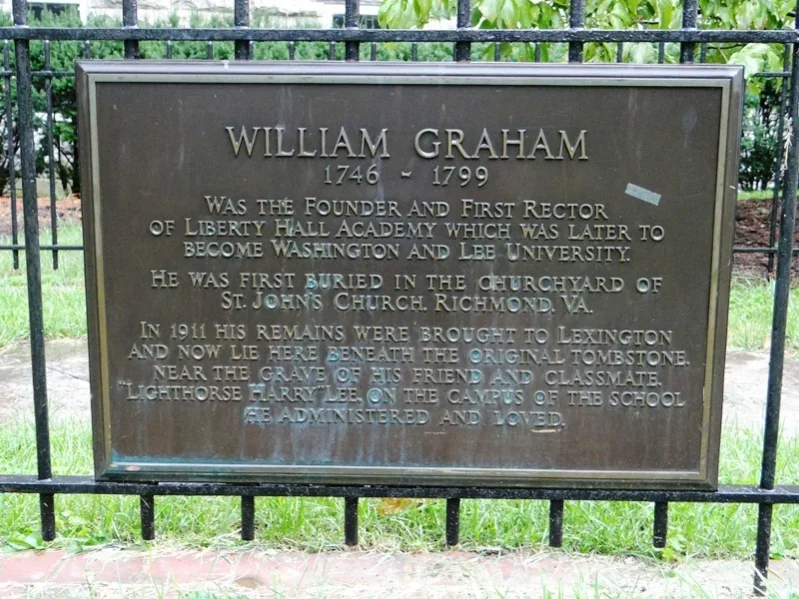
(William Graham Marker at Washington and Lee University | Source: Log College Press)
At Princeton College, the genius, industry and piety, of young Graham soon brought him into notice. He there became acquainted with Samuel Stanhope Smith, through whose instrumentality, as will be presently related, he removed to Virginia. A circumstance occurred while he was at college, that may give some idea of the estimation in which he was held by his fellow students. During the preparation for one of the public examinations, the late Gen. Henry Lee, then a student, requested permission to review with Mr. Graham in his room: assigning as a reason for this request, that he knew Mr. Graham had been more studious than himself; and he considered him better qualified than any of the class, to explain any difficulties that might occur in the course of the review. Mr. Graham at first positively refused, supposing that it would produce a waste of time; as they would insensibly run into conversation unconnected with their studies. Lee insisted, and, at length his request was granted; but upon the express condition, that there should be no conversation on any subject whatever, except that which immediately demanded attention. At the examination, Lee distinguished himself. When it was over, he came into Mr. Graham’s room and said, “Well Graham! I have stood a glorious examination, and I know that I am indebted for it in a great measure to you: what compensation shall I make you?” “Not any,” was the reply. Lee however continued to insist, and Graham to refuse. At length Lee went to his own room, and dashing his pen across his own name in “Belsham’s Lectures on Natural Philosophy” wrote “William Graham” in its stead, and returning to Mr. Graham’s room laid the book on the table and walked off. The book is now in the possession of a relative of Mr. Graham’s in Rockbridge…
On leaving college, Mr. Graham returned to his father’s and immediately after entered on the study of Divinity under the Rev. John Roan. The latter, like other country clergymen, lived on a farm, and depended, in part, on its produce for the support of his family. In the business of farming, however, he succeeded but poorly. His implements of husbandry often got out of repair, and his business became deranged, and he knew not how to repair the one, or set the other in order. Cases of this kind sometimes occurred, which very much perplexed the good old man, and almost induced him to adopt the hasty resolution of abandoning farming altogether. From these perplexities his pupil, when informed of them, generally relieved him. The experience which Mr. Graham had in farming in his youth, together with a ready mechanical invention, and considerable manual dexterity, enabled him in most cases, in a little time, to set all to rights; and where that could not be done, he suggested such plans and expedients as were highly useful. These labors, intended by Mr. Graham only for the benefit of Mr. Roan, were highly useful to himself. His application to study was so great, that without the relaxation and exercise which these services afforded, his health would probably have been greatly injured.
We are now approaching an important period in the life of Mr. Graham. He is soon to enter on the discharge of public duties, and to ascertain from actual experiment, whether the hopes and expectation of his friends would be fulfilled, and whether the education which at so late a period of his life he had with so much difficulty obtained, had fitted him for that usefulness which he had himself fondly anticipated.
The death of his mother had doubtless weakened his attachment to Pennsylvania, and caused him, which much more readiness than perhaps he otherwise would have done, to yield to the advice and solicitation of his friend Mr. Smith, who urged him to come to Virginia.