
Revision Offered, Review Withheld
The university fixed several exposed errors from a recent museum publication, but the underlying problems of review, transparency, and accountability persist.
By Kamron M. Spivey, ‘24
June 10, 2026
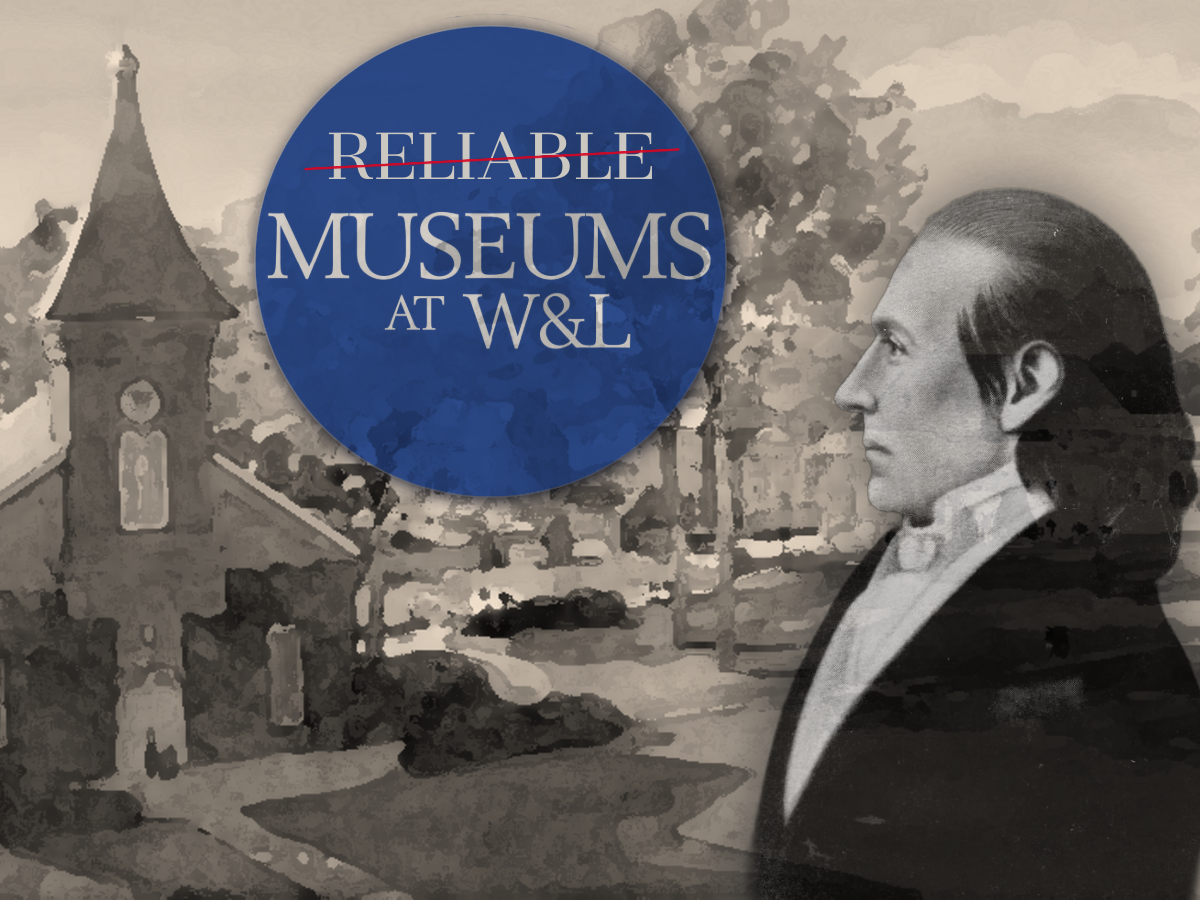
(Rector William Graham overlooks Lee Chapel and the Museums Department logo, as recent corrections raise broader questions about historical interpretation at Washington and Lee. | The Generals Redoubt.)
One day after The Generals Redoubt (TGR) published my op-ed criticizing the scholarly standards of Washington and Lee Museums, the Museums Department quietly revised portions of its webpage on Henry Lee III. The page now bears an automated “Last updated on June 2, 2026” timestamp. But readers are given no indication as to what was changed or why. And a closer review reveals that several obvious issues remain.
Bill Payne — the trustee who oversees the university’s institutional history committee — wrote me a few days later. He acknowledged that “an honest error was made” in the Henry Lee article. The museum had, in fact, corrected several of the identified issues, including the inaccurate date of the Baltimore mob attack of 1812 and a misleading characterization of Henry Lee’s departure from Alexandria.
Payne’s private admission of error is welcome. But a private acknowledgement to a critic falls short of the public correction to readers expected in any serious academic or journalistic setting. More revealing, however, was his response to the criticism itself.
“I would expect that most people in our community would have merely reached out to the author,” Payne continued, “who is a new member of W&L's museums team (with multiple degrees from UNC and a full resume of museum work), and pointed out the error.”
Such a response might be appropriate if the issue were an isolated mistake in a single publication. But my article did not concern Henry Lee alone. It also identified inaccurate interpretation at the Old George statue and the “Jockey” John Robinson obelisk — neither of which university officials have addressed.
Taken together, these errors are indicative of a recurring pattern across years of interpretation.
Even within the revised Henry Lee article, obvious problems remain. One passage still reads: “He was commissioned as a captain by Governor Patrick Henry [dates].” Such unfinished text should not survive publication, much less a post-publication correction. Allowing it to remain reflects a level of editorial care inconsistent with the standards the university expects even of its own students.
This pattern extends beyond Henry Lee. The Museums Department's article on Rev. William Graham, founder and first rector of Liberty Hall Academy, contains a chronological impossibility. It states that “Graham resigned in 1796,” moved West, and then, “on a trip to Richmond … fell ill and died. He was buried there in 1788.”
The same article concludes with a 134-word block quotation about Graham's 1911 reinterment, but fails to identify the author, date, or even the source of the quotation. After considerable research, I was able to trace the passage to a student editorial published in the May 9, 1911 issue of the Ring-tum Phi.
These are not difficult interpretive questions. They are not obscure disputes hidden deep within archival collections. They are the kinds of mistakes that a basic read-through should catch.
My previous article — much like this one — did not attempt to fact-check every statement appearing in museum publications. It sought to identify a troubling pattern within museum culture: the centralization of interpretive authority without the scholarly rigor such authority requires.
The museum's subsequent revisions, and the response from the trustee directing institutional history, have only reinforced that conclusion.
“I would humbly suggest to you,” Payne concluded his email, “that being a reliable historian can be very difficult while also being a full time critic, propaganda writer, and fundraiser.”
Readers may judge for themselves whether TGR's documentation of factual inaccuracies and requests for stronger review constitute propaganda. What matters here is not the label itself, but what it replaces. Rather than addressing the broader concerns raised in my article, Payne shifts attention to the perceived motives of the person raising them.
A department genuinely concerned with accuracy would have examined the editorial practices that allowed these errors to reach publication in the first place. It would have reviewed similar publications, corrected obvious errors elsewhere in the series, and informed readers when substantive revisions were made. Instead, the response was limited to correcting only those errors that had already been caught by the public.
That approach may reduce immediate embarrassment. But it does not restore credibility.
Washington and Lee is investing millions of dollars into an Institutional History Museum that will shape how future generations understand the university's past. Such a project demands exceptional transparency, rigorous sourcing, and a willingness to welcome scrutiny.
And let’s be honest — there has been plenty of scrutiny in recent years. Calls from faculty and students between 2013 and 2016 prompted W&L to better memorialize its historical relationship with slavery. Kent Wilcox, an independent researcher, published a sweeping audit in 2018 which challenged accepted narratives about Washington and Lee’s founding. Five years later, The Spectator and other conservative commentators objected to the abrupt removal of several Confederate memorials, including those to Traveller, Robert E. Lee’s favorite horse. These critics do not share the same politics or priorities. What they do share is a belief that the university’s official historical narrative deserves greater scrutiny than it has received.
The solution is not complicated. The Museums Department should clearly identify its sources, disclose substantive post-publication revisions, and subject future interpretive materials to meaningful independent review. These are not extraordinary demands. They are the minimum standards that Washington and Lee — or any academic community — should expect.
Until those standards are embraced, each new revision will invite the same uncomfortable question: if these are the mistakes that readers have already uncovered, how many more remain undiscovered? Several did not make it into this article. Whether the department finds them on its own may prove more revealing than any response it chooses to publish.