
“Reinterred and Reinterpreted”: Needs Revision
Repeated historical inaccuracies are undermining the credibility of Washington and Lee’s museums project.
By Kamron M. Spivey, ‘24
(Henry Lee and “Old George” stand at the center of recent questions about the Museums Department’s historical accuracy. | The Generals Redoubt)
A quick walk across Washington and Lee University’s campus — or a skim through recent museum publications — reveals a troubling pattern of factual inaccuracies, weak sourcing, and careless historical interpretation. These problems are not isolated mistakes. They raise legitimate concerns about the reliability of the university’s forthcoming chapel galleries and the broader Institutional History Museum project.
Consider the Museums Department’s newsletter series, “Reinterred and Reinterpreted,” which promises “a closer look” at figures buried in the chapel, such as “Light Horse Harry” Lee and his wife, Anne Carter. These articles, however, contain a remarkable number of factual inaccuracies for a publication issued under the university’s institutional authority.
Most egregious of the errors is the claim that, “During his presidency of Washington College (known today as Washington and Lee University), Robert E. Lee visited his father’s grave in 1862.”
Lee did in fact journey to Cumberland Island, Georgia — the original burial site of his father — in January 1862. At that time, Robert E. Lee was a General overseeing coastal fortifications in service of the Confederate States of America. His visit to Cumberland Island was gratifying, he told his wife, Mary — a scenic respite from “the enemy’s gunboats,” which were “pushing up the creek to cut off communication between [Savannah] and Fort Pulaski.” He would not become president of Washington College until October 1865.
Elsewhere, the article misdated the Baltimore mob attack of July 27-28, 1812, during which several antiwar critics under Henry Lee’s protection were beaten, maimed, and killed. “He survived but was incapacitated for life,” the Museums article continued. “Lee visited his family briefly in Alexandria but quickly left to escape creditors and never returned.”
However, Henry Lee’s personal correspondence with President James Madison and Secretary James Monroe indicate that pecuniary concerns were hardly a consideration for his Caribbean retreat. The sickly Lee sought a tropical climate, according to letters housed in the National Archives, for “the agreable prospect of being restored to my usual health & strength.” He didn’t secure this trip from his Alexandria home until nearly a year after the attack — hardly a “quick” escape.
The result of these errors is not serious institutional scholarship, but false narrative presented with institutional authority. And this pattern extends well beyond newsletters.
Take, for example, Washington Hall’s newest display — interpretive signage erected under the directorship of Matt Davis. The signage contextualizes the famous “Old George” statue, claiming it was carved by Matthew Kahle “in 1842 from a tulip poplar log he found floating in the Maury River.”
Yet, the Trustees Minutes of Washington College note that the statue was commissioned on March 13, 1844. And the log itself was pulled from the James River, not the anachronistically identified Maury River. This is not obscure information. It is basic institutional history.
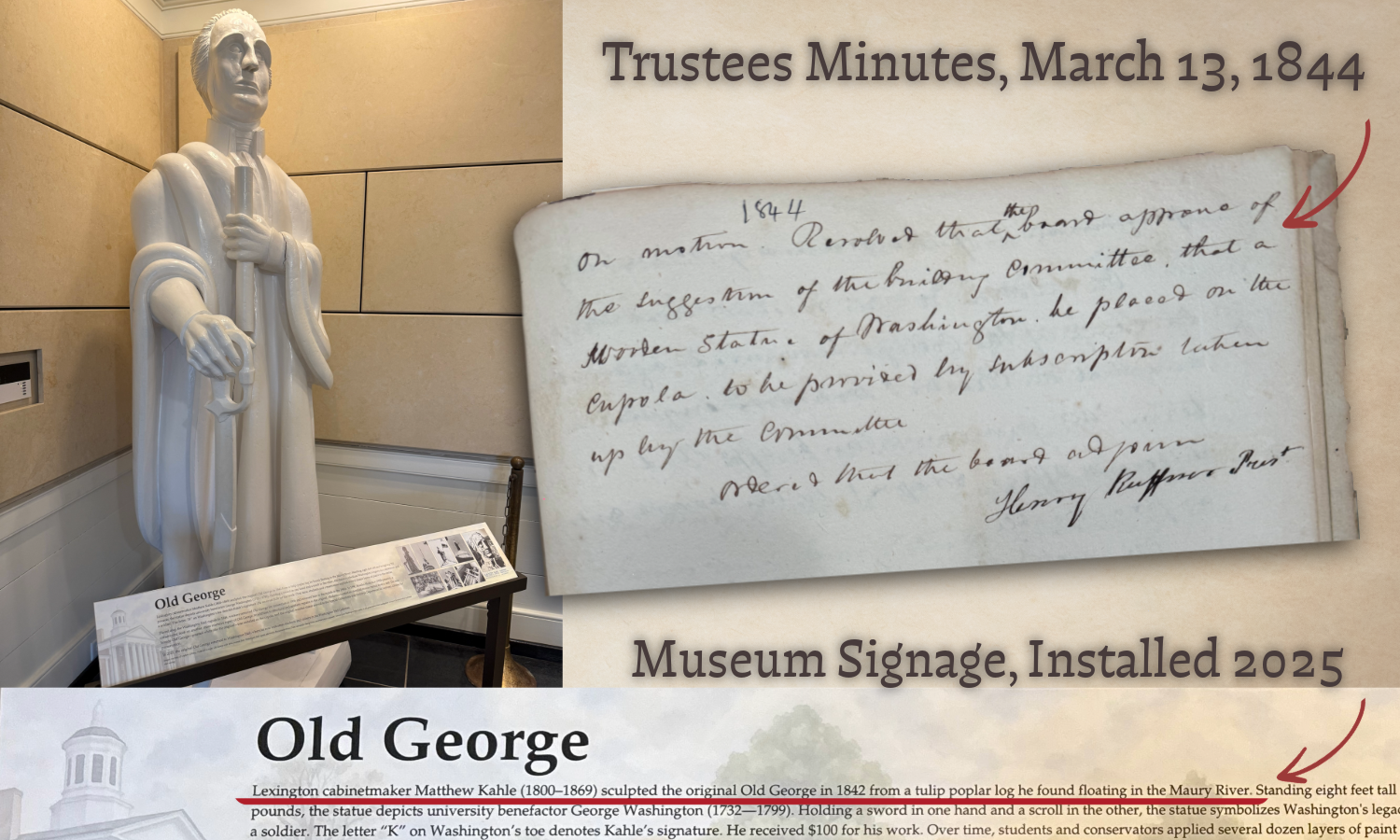
(The Trustees Minutes of Washington College record approval of the original Old George statue on March 13, 1844. Newly installed museum signage states that the statue was carved in 1842. | Washington and Lee University Archives, The Generals Redoubt)
This problem is not unique to Davis's tenure. Interpretive signage installed in 2019 beside “Jockey” John Robinson’s obelisk falsely states that Robinson donated the front-campus land after the devastating 1803 fire destroyed the Academy Building.
In reality, Robinson “proposed to aid with two acres of land” and “100 bushels of corn” on March 3, 1803. That same day, the trustees accepted Andrew Alexander’s proposal to exchange his land — where the Colonnade now sits — with the land the institution owned, “provided the Academy purchase at $60 per acre the contiguous field lands bounded by Woods Creek.”
This essay does not serve to fact-check every detail on campus signs and museum publications. Rather, it identifies a troubling pattern within museum culture: the centralization of interpretive authority without the scholarly rigor such authority requires. That rigor depends upon careful sourcing, meaningful extradepartmental review, and a willingness to subject institutional narratives to broader scholarly scrutiny — practices too often absent from recent museum productions.
Take the “Reinterred and Reinterpreted” series. Despite extensive primary-source material housed in Washington and Lee’s own archives — including six years of exiled correspondence between Henry Lee and his children — the articles rely largely on generalized secondary references and cursory summaries from the Encyclopedia of Virginia.
That problem is compounded by the department’s insularity. Numerous faculty members, alumni researchers, and independent scholars have expressed frustration over their exclusion from meaningful participation in the museum’s editorial and review process.
Professor Alison Bell, a tenured archaeologist and alumna, wrote that “despite asking — Archaeology faculty have been completely excluded from conversations about the Institutional History Museum.”
Similar concerns arose in my own recent correspondence with the university. Last week, I requested an opportunity to tour the renovated chapel galleries before their public reopening, noting that third-party reviews are a common means of strengthening exhibits and building public confidence in them. Bill Payne — the trustee overseeing the museum project — declined, explaining that the university already has “a thorough internal review process in place with the administration and the museum working group.”
The factual inaccuracies discussed above are precisely the sort of errors a robust review process should catch. Their persistence suggests a culture of bureaucratic insularity that is seriously damaging the department’s credibility.
Author and alumnus Garland Tucker, ’69, recently described the museums department as “an institutional apparatchik.” The Spectator likewise accused the administration of presenting a “sanitized history of itself” that “violates the goals of a liberal arts education.”
It is not too late to reverse course. If Washington and Lee wishes to build a credible Institutional History Museum, it must begin by ensuring that its educational materials meet the same standards of accuracy, sourcing, and scholarship to which it holds its students. That requires deeper engagement with primary sources, meaningful collaboration with faculty and independent researchers, and a greater willingness to welcome — rather than exclude — outside expertise.
An Institutional History Museum built on shallow scholarship, administrative insularity, and institutional self-protection risks becoming precisely what its critics fear: not a place of serious historical inquiry, but an apparatus more concerned with controlling institutional narrative than pursuing historical truth.