
[An article from the 1926 Alumni Magazine details the interest surrounding Robert E. Lee’s horse Traveller. For more information, please visit W&L Special Collections.]
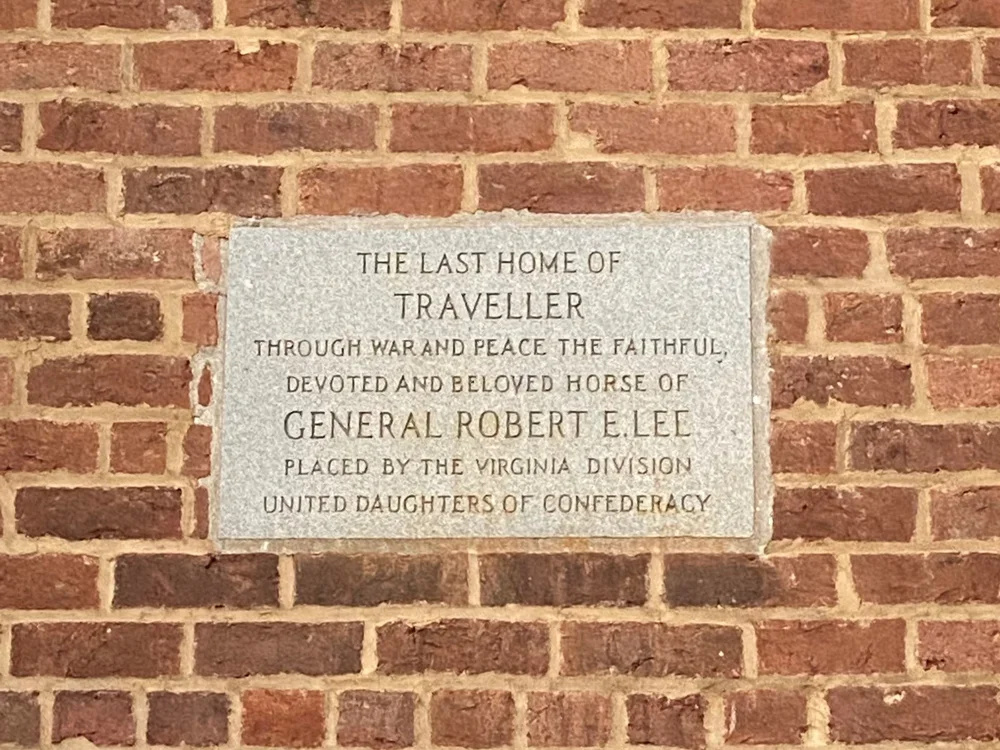
(Traveller Plaque, formerly on Lee House | Source: W&L Spectator)
Lexington, Va.—An object of peculiar interest to visitors at the Washington and Lee University museum is the skeleton of “Traveller,” famous war horse of General Robert E. Lee.
Few know that the skeleton is preserved here. General Lee bought “Traveller” shortly after the start of the war in the western part of Virginia, now West Virginia, and used him throughout the war.
When General Lee came across the mountains in I865 to become president of Washington College, it was again “Traveller” he rode. Even in death “Traveller” was not missing, for he was led in the funeral procession of General Lee in 1870. When the horse died, it was buried in Lexington.
In 1907, the idea of having the skeleton mounted was advanced, and Joseph Bryan, of Richmond, donated the funds to make it possible. Since then, “Traveller” has occupied a prominent place in the Washington and Lee museum.
“‘Traveller’ was a mighty proud horse,” says C. H. Chittum, 77-year-old Lexington resident. “I’ve seen him many a time coming up the street, and he wouldn’t look to right or left. He looked like just the horse for General Lee.”
For an artist who wanted to paint a picture of “Traveller,” General Lee described him:
“If I were an artist, like you, I would draw a picture of “Traveller, representing his fine, muscular proportions, muscular figure, deep chest, and short back, strong haunches, flat legs, small head, broad forehead, delicate ears, quick eye, small feet, and black mane and tail. Such a picture would inspire a poet, whose genius could then depict his worth and describe his endurance of toil, hunger, thirst, heat and cold, and the dangers and sufferings through which he passed. He could dilate upon his sagacity and affection and his invariable response to every wish of his rider. He might even imagine his thoughts through the long night marches and days of battle through which he passed. But I am no artist; I can only say he is a Confederate gray.”