
Washington Engages British Forces at Harlem Heights (September 1776)
[In a letter to his brother, George Washington recaps the retreat from Long Island as well as the ensuing Battle of Harlem Heights, which gave the Continental Army a much-needed victory. For further reading, please visit the Hathi Trust Digital Library to view The Writings of George Washington. This highlight is part of our ongoing Legacies of Liberty series, where we celebrate Washington and Lee’s Revolutionary founders.]
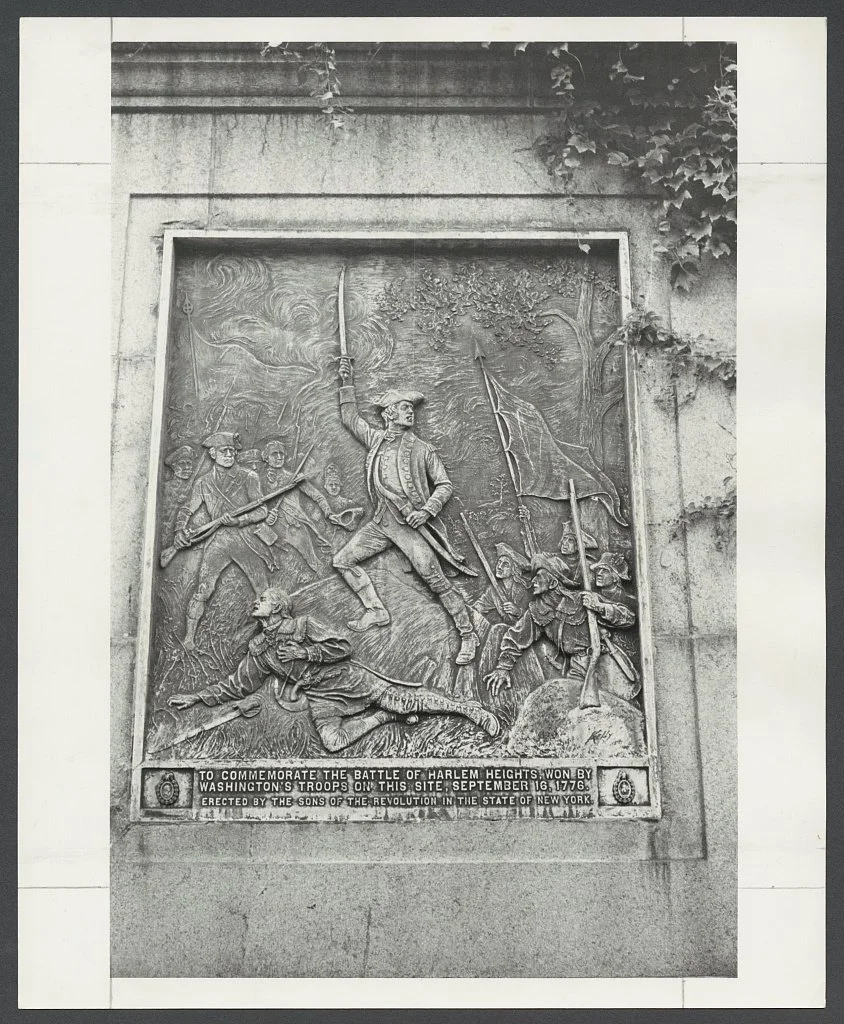
(Monument commemorating the Battle of Harlem Heights | Source: Library of Congress)
To John Augustine Washington
Heights of Harlem, 22 September 1776
Dear Brother,
My extreme hurry for some time past has rendered it utterly impossible for me to pay that attention to the letters of my friends, which inclination and natural affection always inclines me to. I have no doubt, therefore, of meeting with their excuse, tho’ with respect to yourself I have had no letter from you since the date of my last saving the one of Septr. the 1st. With respect to the attack and retreat from Long Island, the public papers would furnish you with accounts nearly true. I shall only add that in the former we lost about eight hundred men, more than three fourths of which were taken prisoners. This misfortune happened in a great measure by two detachments of our people, who were posted in two roads leading thro’ a wood, in order to intercept the enemy in their march, suffering a surprise, and making a precipitate retreat, which enabled the enemy to lead a great part of their force against the troops commanded by Lord Stirling, who formed a third detachment, who behaved with great bravery and resolution.
As to the retreat from the Island, under the circumstances we then were, it became absolutely necessary, and was effected without loss of men, and with but very little baggage. A few heavy cannons were left, not being movable on account of the ground being soft and miry, thro’ the heavy and incessant rains which had fallen. The enemy’s loss in killed we could never ascertain, but many reasons to believe, that it was pretty considerable, and exceeded ours a good deal. Our retreat from thence, as I said before, was absolutely necessary, the enemy having landed the main body of their army to attack us in front, while their ships of war were to cut off all communication with the city, from whence resources of men and provisions were to be drawn.
Having made this retreat, not long after we discovered, by the movements of the enemy and the information we received from deserters and others, that they declined attacking our lines in the city, and were forming a plan to get in our rear with their land army, by crossing the sound above us, and thereby to cut off all intercourse with the country and every necessary supply. The ships of war were to cooperate, possess the North River, and prevent succors from the Jerseys, &c. This plan appearing probable, and but too practicable in its execution, it became necessary to guard against the fatal consequences that must follow if the scheme were effected; for which purpose I caused a removal of a part of our troops and stores from the city; and a council of general officers determined, that it must be entirely abandoned, as we had, with an army weaker than theirs, a line of sixteen or eighteen miles to defend, to keep open our communication with the country besides the defense of the city. We held up, however, every show of defense until our sick and all our stores could be brought away. The evacuation being resolved upon, every exertion in our power was made to baffle their designs and effect our own. The sick were numerous, amounting to more than the fourth part of our whole army, and an object of great importance. Happily we got them away; but before we could bring off all our stores, on Sunday morning six or seven ships of war, which had gone up the East River some few days before, began a most severe and heavy cannonade, to scour the grounds and effect a landing of their troops. Three ships of war also ran up the North River that morning above the city, to prevent our boats and small craft from carrying away our baggage, &c.
I had gone the evening before to the main body of our army, which was posted about these heights and the plains of Harlem, where it seemed probable, from the movements and disposition of the enemy, they meant to land and make an attack the next morning. However, the event did not happen. Immediately on hearing the cannonade, I rode with all possible expedition towards the place of landing, and where breastworks had been thrown up to secure our men; and found the troops that had been posted there, to my great surprise and mortification, and those ordered to their support (consisting of eight regiments) notwithstanding the exertions of their generals to form them, running away in the most shameful and disgraceful manner. I used every possible effort to rally them, but to no purpose; and, on the appearance of a small part of the enemy, (not more than sixty or seventy) they ran off without firing a single gun. Many of our heavy cannon would inevitably have fallen into the enemy’s hands, as they landed so soon, but this scandalous conduct occasioned a loss of many tents, baggage, and camp equipment, which would have been easily secured had they made the least opposition.
The retreat was made with the loss of a few men only. We encamped, and still are, on the Heights of Harlem, which are well suited for defense against their approaches. On Monday morning, they advanced in sight in several large bodies, but attempted nothing of a general nature, tho’ there were smart skirmishes between their advanced parties and some detachments from our lines, which I sent out. In these our troops behaved well, putting the enemy to flight in open ground, and forcing them from posts they had seized two or three times. A sergeant, who deserted from them, says they had, as he was told, eighty-nine wounded and missing besides slain, but other accounts make the wounded much greater. Our loss in killed and wounded was about sixty, but the greatest loss we sustained was in the death of Lieutenant-Colonel Knowlton, a brave and gallant officer. Major Leitch of Weedon’s Regiment had three balls through his side and behaved exceedingly well. He is in a fair way of recovery. Nothing material has happened since this. The enemy, it is said, are bringing up their heavy cannon, so that we are to expect another attack soon, both by land and water, as we are upon the Hudson (or North River) at the place where we have attempted to stop the navigation by sinking obstructions in the river and erecting batteries.
The dependence, which the Congress have placed upon the militia, has already greatly injured and I fear will totally ruin our cause. Being subject to no control themselves, they introduce disorder among the troops, whom you have attempted to discipline, while the change in their living brings on sickness, this makes them impatient to get home, which spread universally, and introduces abominable desertions. In short, it is not in the power of words to describe the task I have to act. Fifty thousand pounds should not induce me again to undergo what I have done. Our numbers, by sickness, desertion, &c. are greatly reduced. I have been trying these four or five days to get a return, but have not yet succeeded. I am sure, however, we have not more than twelve or fourteen thousand men fit for duty, whilst the enemy, who it is said, are very healthy, cannot have less than near twenty-five thousand. With sincere love to my sister and the family, and compliments to any inquiring friends, I am, &c.