
Washington and Lee once trusted its students to choose the classmate who would speak for them. A century after that responsibility was surrendered, the University should give it back.
By Kamron M. Spivey, ‘24
with additional research by Veronica Cargill, ‘27
I. When One Became Many
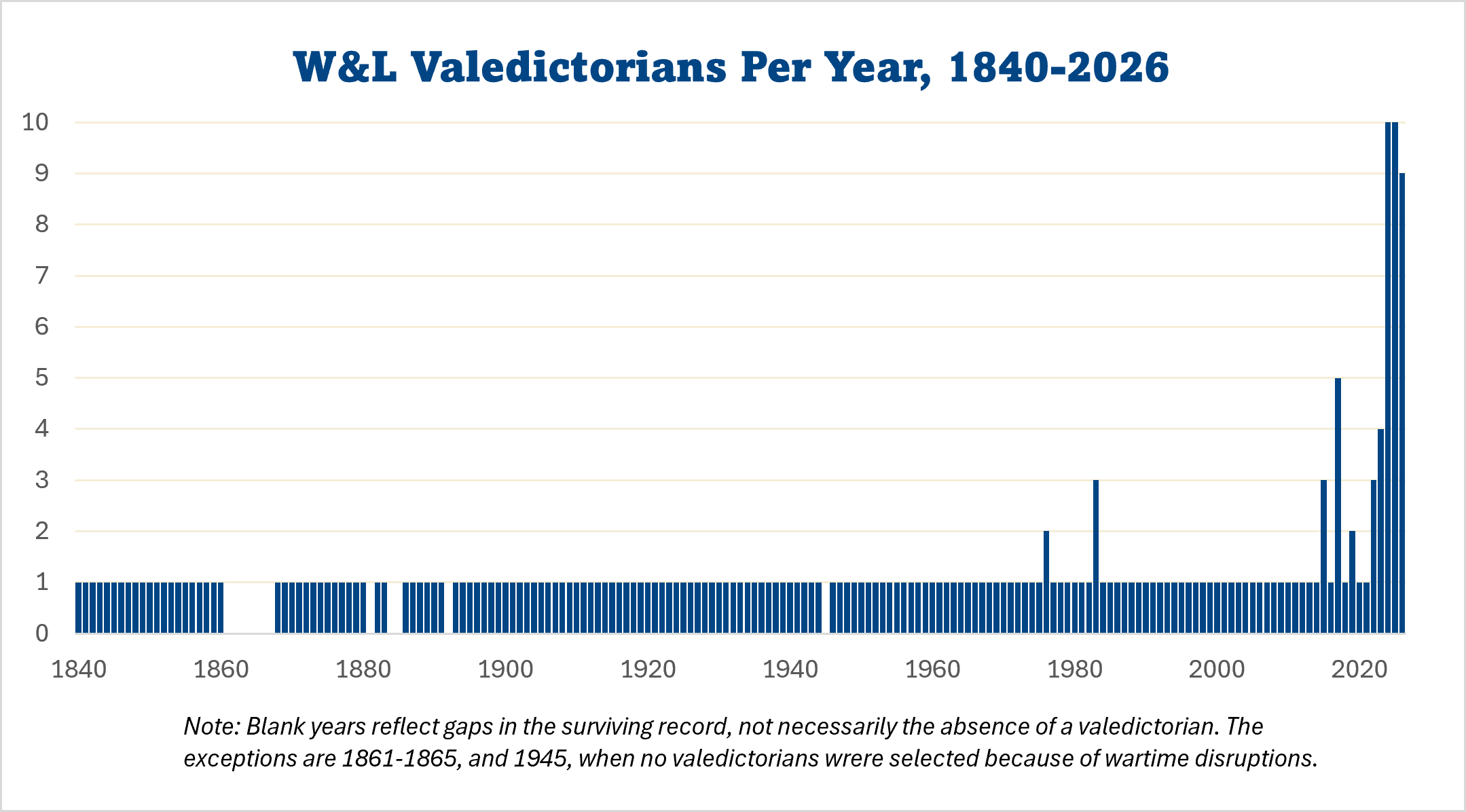
For most of Washington and Lee’s history, the valedictorian was a singular distinction. From 2000 through 2014, the University graduated fifteen classes and named fifteen valedictorians. Since 2015, it has named fifty.
This surge, which has resulted in nine valedictorians this spring and ten each in 2025 and 2024, has coincided with a remarkable rise in grades. Over the past two decades, W&L’s median GPA climbed from 3.26 in 2005 to 3.73 in 2025, with increases throughout the grade distribution. As more students reach the top of the scale, a system that automatically assigns the valedictory to the highest academic average inevitably loses its ability to identify a single student.
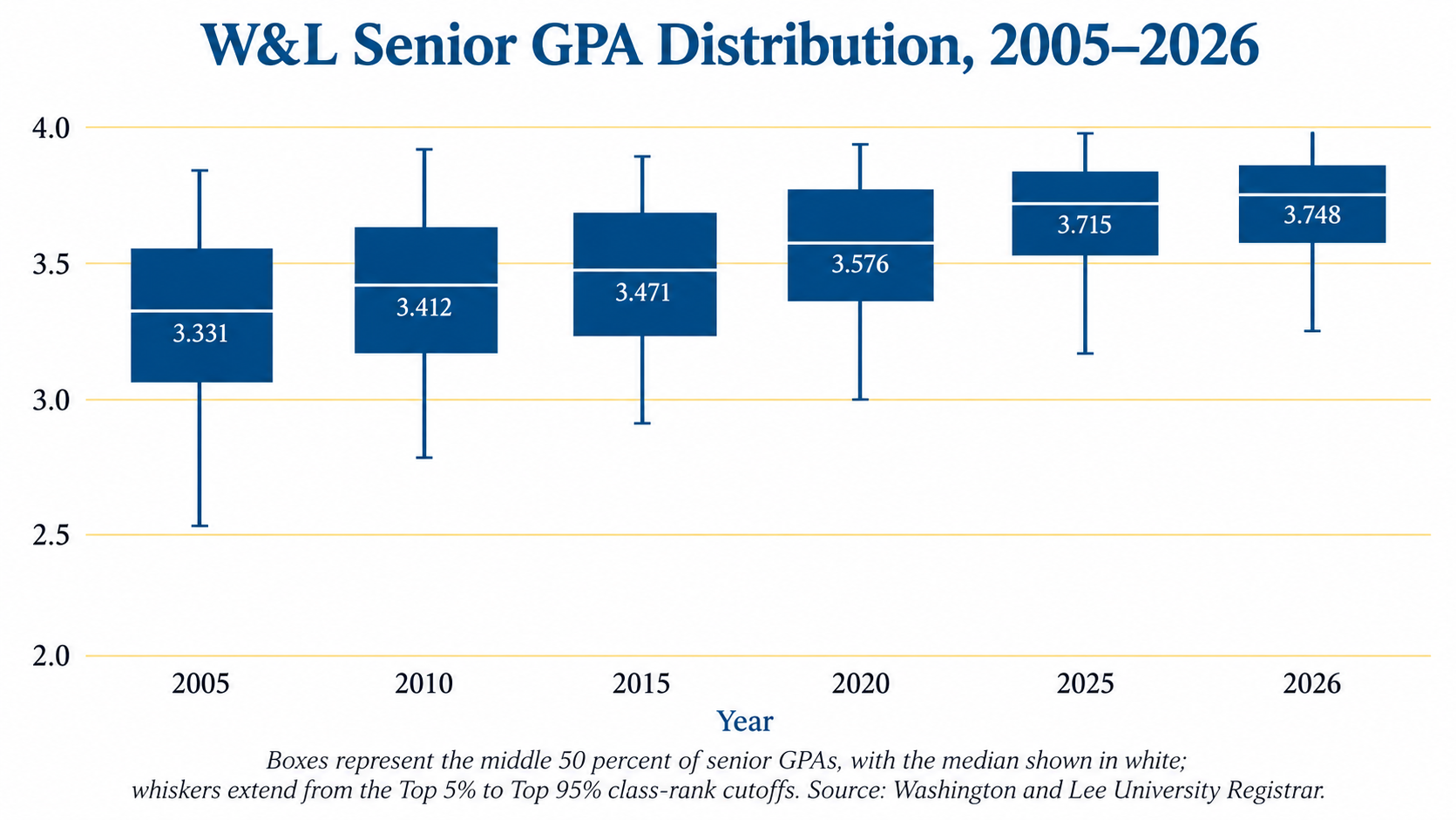
The problem of grade inflation — and its erosion of valedictory prestige — is undeniable. The solution, however, may lie in an earlier valedictorian crisis that consumed Washington and Lee some ninety years ago.
Strangely, theirs was the opposite dilemma. Seniors then elected their valedictorian, but by the 1930s students could hardly be persuaded to participate. Elections faltered, campus politics intruded, and the office itself nearly disappeared. The resulting crisis would produce the rule governing the commencement honor today. To understand what went wrong — and what it might teach us now — we need to go back to the origins of the Washington and Lee valedictorian.
II. History of the Valedictory
During his 1849 inaugural address, President George Junkin described the faculty of Washington College as a “court of conscience,” vested with “parental authority” over the students. Antebellum professors directed academic affairs, supervised examinations, and enforced stringent disciplinary rules.
That authority extended to the selection of the valedictorian.
The earliest surviving faculty minutes begin in 1840, when William W. Trimble, later a Presbyterian minister, received the title. The following year, the faculty appointed John Q. James of Richmond to deliver the valedictory. In 1842, they selected William L. Lancaster, and then, in 1843, Jacob Henry Smith, another future minister.
In appointing the valedictorian, however, faculty did not prioritize academic rank. Commencement featured several student honors, including the Cincinnati Oration and the Latin and Greek Salutatory. The former — established in 1838 — was typically awarded to the class’s top scholar for an address on the American Revolution and the principles of civil liberty.
Out of twelve full-time seniors in 1853–54, William T. Price stood first and, consequently, delivered the Cincinnati Oration. The valedictory, however, fell to Rutherford R. Houston, who ranked fifth in his class and held the second-to-lowest standing in Greek and personal Conduct.
This pattern continued. In 1856, W. H. Brooks, fourth in his class, delivered a valedictory described by the Lexington Gazette as having met with “very general and decided favor.” And in 1857, A. H. Jackson enjoyed the honor despite standing ninth in a class of ten.
Although they left little record of their deliberations, Washington College faculty enjoyed considerable discretion in choosing the student who would deliver his class farewell.
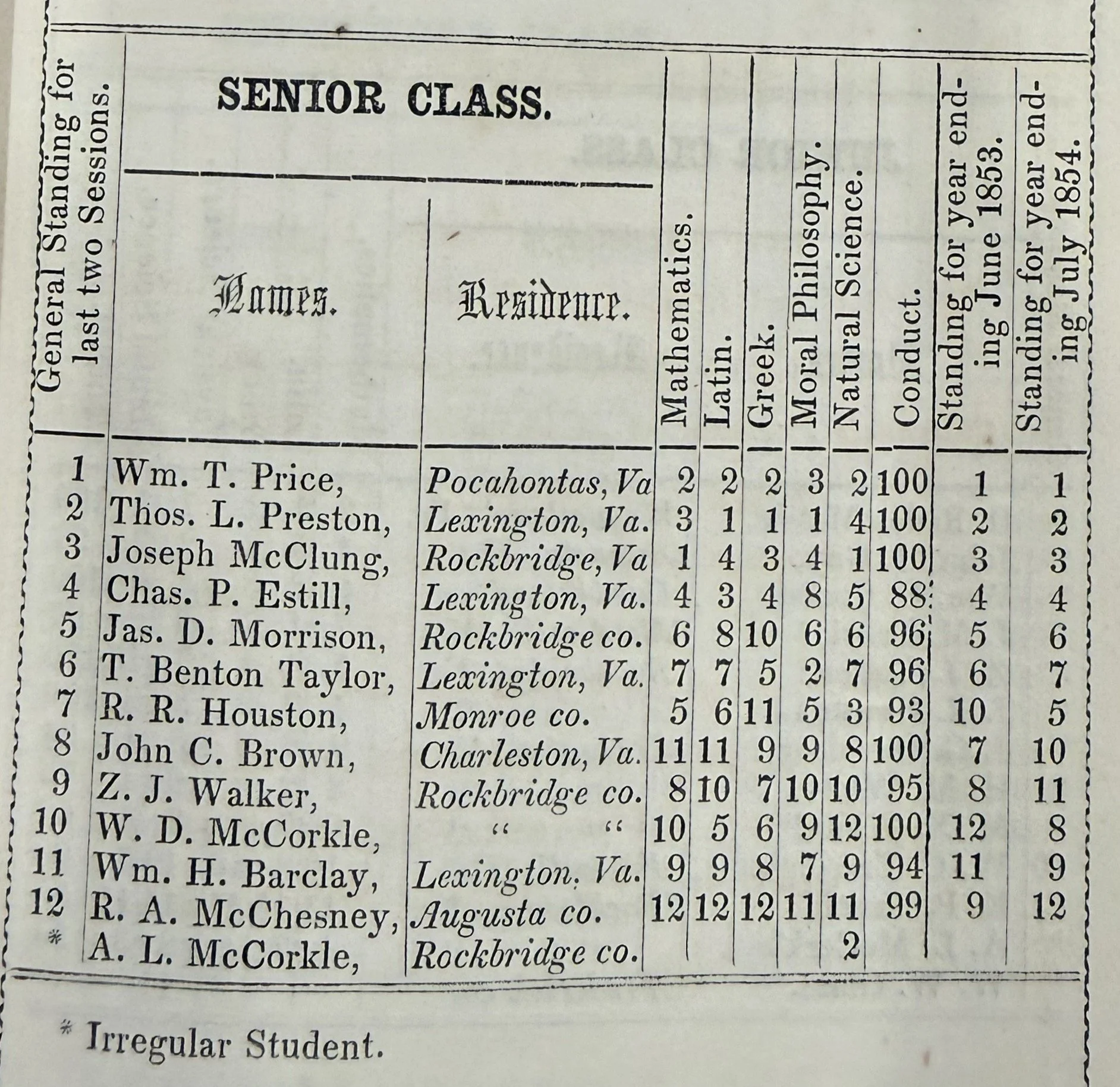
(Page Five from the 1854 Catalogue, showcasing student performance in each subject. R.R. Houston stood fifth in class rank, a significant jump from the previous year, and would deliver the valedictory address.)
“Selected by His Fellow Graduates”
Then Robert E. Lee came to Lexington, bringing with him a markedly different approach to institutional authority.
Rather than extend faculty supervision over every aspect of student life, the former General loosened it. As Neely Young ’66 has presented in his 2023 study of the Honor System, “Lee supported individual responsibility and student self-governance in all things.” This dramatic divergence from his Presbyterian predecessors was evident across college life — from athletics and fraternities to religious participation and the curriculum.
The valedictory offers another particularly clear example.
Lee’s first two Washington College catalogues contain no published rule governing selection of the valedictorian. But in 1867–68, new provisions appeared under “College Honors” which distinguished faculty selection from student selection of commencement orations.
The Cincinnati Oration was to “be awarded to that Graduate … who shall be judged by the Faculty to have attained the highest degree of general Scholarship.”
“The Valedictory Address,” however, “shall be awarded to that Graduate who shall be selected by his fellow Graduates.” (Emphasis added.)
For the first time, and under Lee’s presidency, the College entrusted the senior class with election of its own valedictorian. This practice would become a defining characteristic of Washington and Lee University in the succeeding decades.
In 1904, The Ring-tum Phi praised David Hopkins Rolston’s valedictory, which reflected on college life, campus traditions, and the graduates’ responsibilities as alumni. “He certainly proved,” the paper declared, “that his class was wise in one thing — the selection of a valedictorian.”
When the System Broke Down
Three decades later, confidence in student election had collapsed. A 1935 edition of The Phi described the process as “little more than a farce that detracted from the honor of the position … and the traditions of the University.”
Numerous incidents fueled this shift in opinion.
In 1933, seniors elected an ineligible law student as valedictorian. As embarrassing as this oversight was to election credibility, student columnists took the occasion to condemn yet another problem, that the election had acquired a “political stigma” which disfavored ranking scholars. A similar article censured the “campus politicians” who simply “persuade the most fraternity brothers” to win the valedictory, which, the author warned, was close to becoming “another of the political plums.”
If the process was too political, it was hardly democratic: only thirteen seniors — roughly ten percent of those eligible — bothered to vote in 1934.
Nevertheless, the first proposed remedies sought to preserve student selection rather than replace it.
The Phi suggested restricting eligibility to members of Phi Beta Kappa and asked faculty merely to suggest candidates. As the crisis continued, however, consensus began to fracture over whether students should continue to select their valedictorian.
Voter participation had reached an embarrassing low. The Executive Committee intervened in 1935, declaring the position appointive. But only a single candidate, William Sphar, even bothered to apply. The EC then petitioned the faculty to make the appointment entirely, citing that they were “best qualified to make the choice.”
Only five seniors attended a meeting of the senior class in May 1936, unanimously voting to abolish the office. Although the EC ultimately intervened and overturned this vote, the case was clear: the senior class had abandoned its responsibility.
Responding to the 1936 vote, and years of mounting student apathy, Dean Robert Henry Tucker observed, “I am sorry to see the position of valedictorian abolished. It was a fine old tradition on this campus.”
If students would not sustain the tradition themselves, Tucker was prepared to intervene.
He established a faculty committee to address the issue and — alongside valedictorian Morton Brown — echoed student demands for higher scholastic qualifications and speaking ability among candidates.
The committee made its decision in December 1937: henceforth, the valedictorian would be the candidate for the B.A. or B.S. degree with the highest scholastic record.
The reformers had good reason to act. As The Phi best described it, “This office had fallen into dispute during the last few years here, and several times steps had been inaugurated to improve its condition, but had always met with failure.”
Academic rank offered a simple solution to a process that had become nearly unworkable. But in adopting it, Washington and Lee surrendered a distinctive tradition of student self-government.
III. When the Solution Became the Problem
For most of the intervening century, that tradeoff left little cause for concern. Former generations of students rarely earned a perfect transcript. Ask an alumnus about grades and he may fondly recall the “Gentleman’s C.”
The valedictorian, nevertheless, stood among the best and brightest of Washington and Lee men.
Charles Royce Hough III ’59 offers a great example. Hough graduated as valedictorian with a 2.857 average — on the three-point scale then used by the College. He was also student body president, a lacrosse player, and a member of Beta Gamma Sigma, Omicron Delta Kappa, and Phi Beta Kappa. Hough went on to live a remarkable life of professional achievement and university service, remembered by fellow alumnus Gerald Malmo ’79 as “the embodiment of the consummate Washington & Lee gentleman.”
With coeducation in 1985, W&L entered a new academic era, marked by a larger and more competitive student body. Perfect academic records became increasingly common among subsequent valedictorians. The valedictory itself has been remarkably balanced: since the first class of women graduated in 1989, exactly thirty-one men and thirty-one women have received it.
That first class was led by John D. Boller, whose whopping 4.148 GPA was, according to the Alumni Magazine, the highest ever recorded at Washington and Lee.
The academic world is changing still. Increasingly competitive graduate schools and job markets reward high grades, helping push averages upward. The result is a grading environment very different from the one in which the 1937 rule was devised.
Changes are also evident in the academic makeup of the valedictory.
From 1966 through 2022, roughly two-thirds of Washington and Lee valedictorians had at least one STEM major. Since 2023, that share has fallen to just 42 percent.
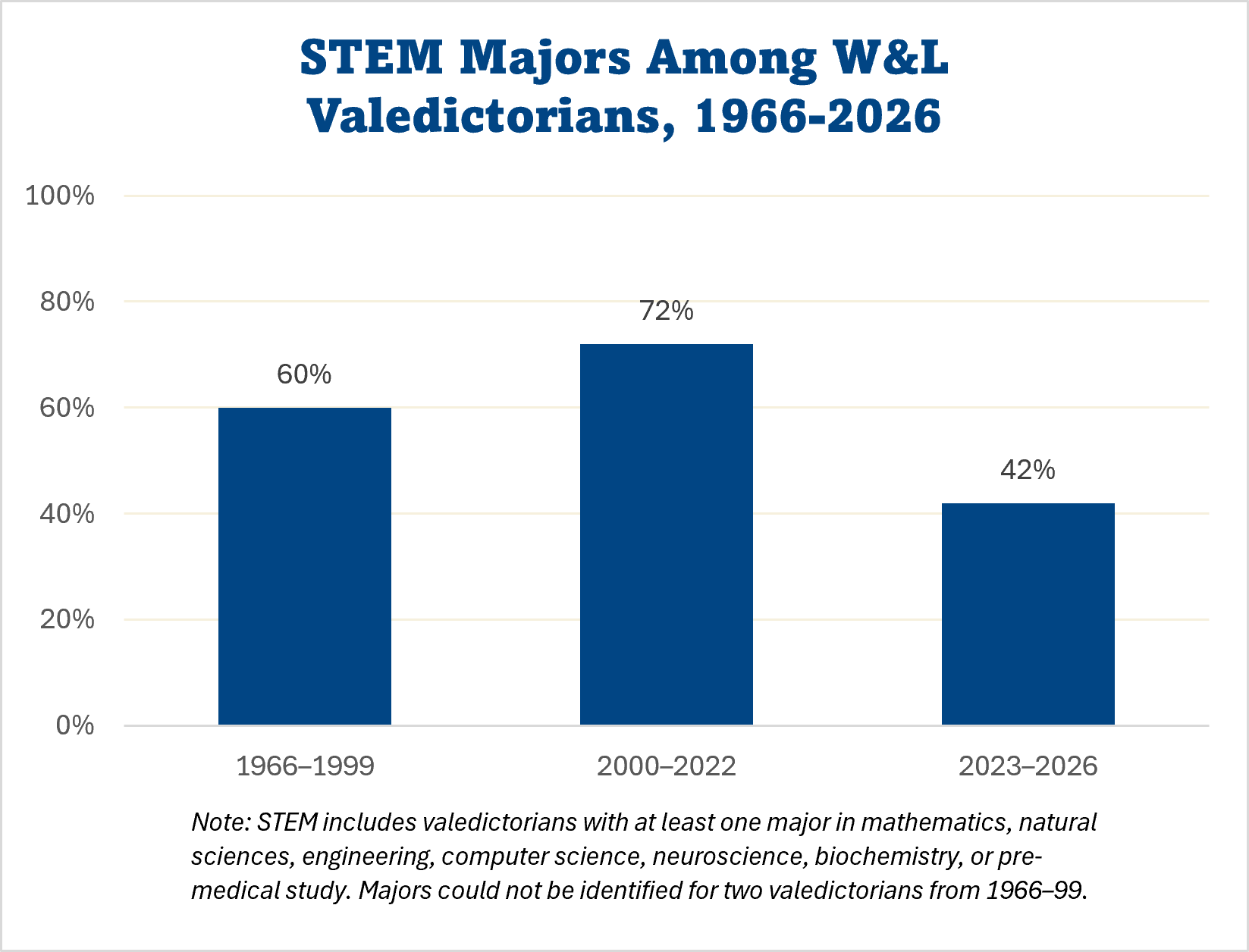
The recent decline in STEM valedictorians is striking, but it also illustrates a larger problem with the current rule. A GPA earned in one discipline is not necessarily equivalent to the same GPA earned in another. The current system makes no such distinction.
As perfect records multiply, disciplinary differences in grading carry greater consequences. For students in STEM fields, those differences can make the valedictory harder to earn.
How, then, should Washington and Lee respond? Return the choice to students, protect it with the safeguards history proved necessary, and make the valedictory a singular distinction once more.
Restoring Choice, Protecting the Process
Giving students the choice again does not mean repeating the mistakes of the 1930s. Insufficient academic qualifications, fraternity politics, and student apathy all contributed to the collapse of Dean Tucker’s “fine old tradition.” A new system should begin by limiting the choice to students of unquestioned academic distinction.
A demanding GPA or class-rank threshold could provide that qualification. Phi Beta Kappa membership, as The Phi proposed ninety-three years ago, offers another possible measure. Faculty should help identify candidates whose records demonstrate exceptional scholarship and academic rigor. And alumni, who hold great knowledge of and affection for Washington and Lee’s traditions, could offer another valuable counsel.
From among those candidates, however, the senior class must make the final choice.
The obvious objection is the same one that doomed the old system: students may simply refuse to participate. The concern is hardly theoretical. Within the last few years, writers for The Spectator have described students as having “largely disengaged” from self-government, citing low election turnout and small pools of candidates for Executive Committee positions.
But recent debates over the Honor System offer a source of optimism. According to EC President John Beekman Youngblood ’27, the latest White Book review drew responses from roughly 950 students, while its committee conducted more than 150 interviews across the University. In a campaign speech for that contested office this spring, Youngblood pledged “to leave this system better than I found it,” so that it might thrive for generations to come.
His election is a testament to the student body’s ongoing concern for the future of Washington and Lee’s institutions.
Nor should we be dissuaded by the “political plums” and “student politicians” decried in the 1930s. W&L’s own pupils — from Rolston, Class of 1904, to Hough, ’59, Boller, ’89, and Youngblood, ’27 — offer ample evidence that campus leadership and genuine distinction need not be at odds. When Washington and Lee men and women believe one of their traditions is genuinely at stake, they will organize around it and take responsibility for its future.
W&L can preserve what the 1937 committee got right without abandoning what came before it: establish rigorous academic qualifications; seek faculty counsel and alumni perspective; then entrust the senior class with choosing — from among its most accomplished members — the one student best suited to speak for it.
In returning that responsibility to students, Washington and Lee would revive a tradition rooted in Robert E. Lee’s confidence that students could best govern themselves.
Kamron M. Spivey ’24 serves as Executive Director of The Generals Redoubt, leading its programs, research, and operations at Fancy Hill. An Honors graduate in History, his writing focuses on the history and traditions of Washington and Lee.
Veronica Cargill ’27 served as a Research Fellow with The Generals Redoubt this summer, tracing the history of W&L’s valedictorian tradition through University catalogues, student newspapers, and other archival sources. Her research provided the foundation for this article.