
Two-thirds of the plaques removed or relocated by Washington and Lee officials this decade remain missing from public display — and most have no connection to the Confederacy.
By Kamron M. Spivey, ’24
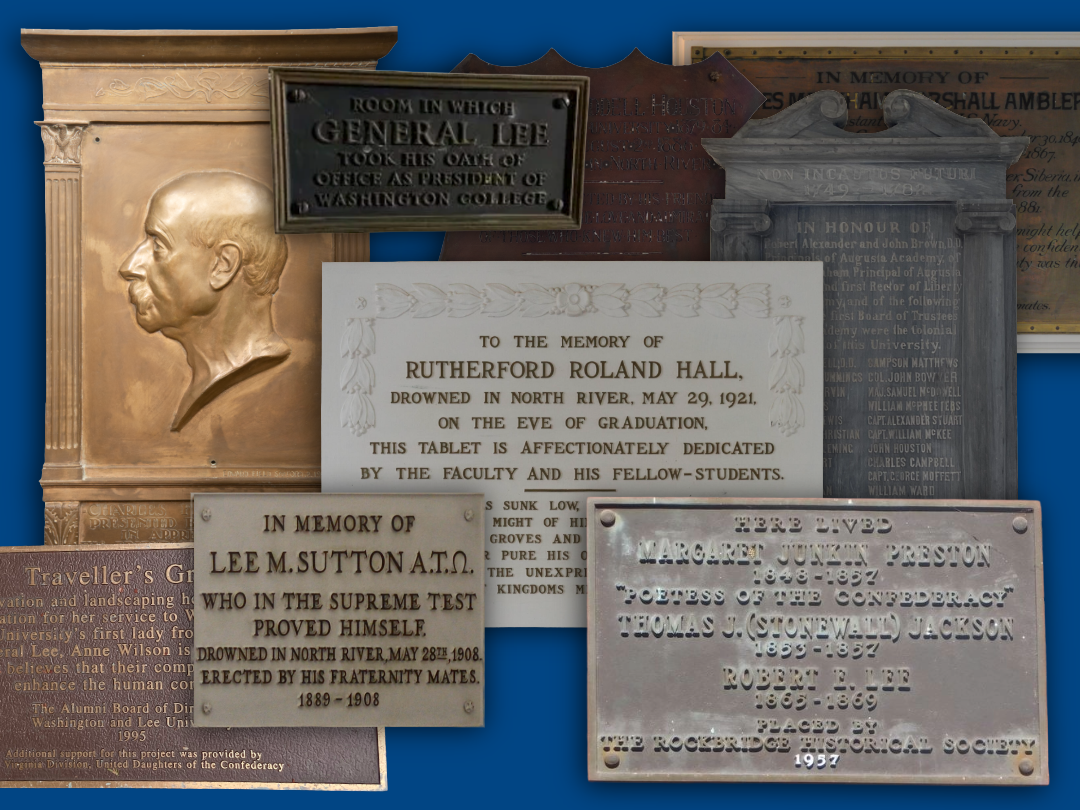
(A selection of the thirty historical plaques documented in The Generals Redoubt’s new public catalogue. Removed from their original locations by Washington and Lee University officials, twenty of these memorials remain out of public view. | Source: The Redoubt)
Washington and Lee University officials have removed at least thirty plaques and memorials from their original locations over the last six years. Twenty remain missing from public display, and the university has refused to publicly disclose their condition or even provide an itemized list of everything it has removed.
That is why The Generals Redoubt (TGR) has produced a comprehensive, public catalogue — “Removed Plaques” — documenting these thirty memorials, their inscriptions, historical significance, original locations, and present status.
Sadly, this catalogue is not exhaustive, and it likely never will be. Despite multiple requests for information this fall, university officials have not responded to our inquiries.
What Justified Their Removal?
The largest wave of removals began in June 2021, when the Board of Trustees announced plans to “restore [the chapel's] unadorned design.” Several years of alterations followed, concluding this summer with the opening of a reinterpreted chapel museum and statue chamber. Despite years of planning and renovation, the university never published a comprehensive list of the memorials removed during that process, or even disclosed how many chapel plaques and inscriptions — twenty in total — it had taken down.
The university's most substantial statement regarding the removal of campus memorials came in July 2023, following its unannounced removal of four additional plaques, including the original headstone of Traveller, Robert E. Lee's beloved horse.
“W&L is an educational institution,” the university stated on The Columns, “and, as such, its campus is not a museum or an appropriate repository for Confederate artifacts. In keeping with this principle, over a year ago, the Board determined that these plaques should be relocated to educational exhibitions.”
By this reasoning, plaques marking where Traveller lived and was buried, and where Lee took his oath of office and worked as president of Washington College, were all considered “Confederate artifacts.” As TGR reported in August, those promised exhibitions were never installed. None of the four plaques has returned to public display.
The university also singled out plaques “placed by third parties such as The United Daughters of the Confederacy.” Five of the thirty memorials in our catalogue have connections to the UDC, although senior university officials participated in the dedication of each one.
But five of thirty is an awfully small number. Even counting every plaque that mentions Robert E. Lee, only one-third of those removed had any reference to him. If the university's concern was “Confederate artifacts,” what justified removing the remaining two-thirds?
The largest group of removed memorials honored students and alumni who died tragically, often while attempting to save others.
Consider William C. Lynch, whose marble tablet was installed in Lee Chapel four years before the Recumbent Lee statue. Lynch died on Christmas Day in 1878 while rescuing a friend who had fallen through the ice on the North (Maury) River.
Or Rutherford Roland Hall, a popular student and editor-in-chief of The Ring-tum Phi, who drowned on the eve of his graduation in 1921. His friends erected a memorial in his honor, with The Phi soliciting contributions toward the tablet.
Other chapel memorials honored alumni who died in military service.
In October 2022, the university reinstalled three chapel plaques honoring veterans at the Memorial Gateway, erected after World War I and later expanded to honor alumni who served in subsequent conflicts.
“The plaques belong here,” declared Rector Mike McAlevey, ’86, during the ceremony. “They join the names of our fellow alumni who made the ultimate sacrifice in service to their country.”
But university officials have not reinstalled the bronze memorial honoring James Markham Marshall Ambler, a Washington College alumnus and United States Navy surgeon. After his ship, the Jeannette, was crushed by Arctic ice in 1881, Ambler remained with several incapacitated crewmates during their desperate struggle for survival, caring for them until he, too, perished.
The second-largest group of removed memorials recognized university leadership and benefactors. One honored the institution's founding trustees. Another thanked the university for allowing the U.S. Army's School for Personnel Services to occupy campus during World War II. A third — removed during Early-Fielding's demolition this summer — recognized E. Marshall Nuckols, ’33, ’35L, the first trustee elected by popular alumni vote in 1969.
Replacing the Historical Record
University officials have also replaced six historical memorials with new markers that alter or omit portions of their original inscriptions.
The Garden Club of Virginia's original terrace plaque outside Lee Chapel dedicated its landscaping contributions “In Reverent Memory of General Robert E. Lee.” The first of these thirty plaques removed, its replacement eliminated that dedication at the university's request, according to The W&L Spectator.
The university also replaced interpretative museum signage at Traveller's grave, installed by previous scholars to explain the site to visitors. The replacement removes references to Lee's Confederate service and the United Daughters of the Confederacy, who maintained the chapel and its grounds for decades.
These are not insignificant editorial changes, and they certainly don’t nullify the university’s historic association with the Confederacy. All these replacements do is intentionally mislead students and visitors about that history.
To date, the university has reinstalled ten of the thirty memorials documented in our catalogue. Nine came from the Lee Chapel sanctuary, while the tenth was recently relocated from the Lee Family Crypt. The remaining twenty have not returned to public display.
More Than Names on a Wall
These thirty memorials represent far more than thirty pieces of bronze and marble. Each tells a story about someone the Washington and Lee community once considered worthy of commemoration.
Lynch's classmates wanted future students to remember his sacrifice. Hall's friends raised money so his name would endure. Generations of alumni contributed their time and resources to honor students, veterans, trustees, and benefactors whose lives exemplified the character, service, and personal honor that Washington and Lee has long sought to cultivate.
The university accepted these memorials, participated in their dedications, and displayed many of them for more than a century. Yet within less than a decade, officials have removed them from their walls — often without public explanation or community consultation.
We encourage alumni, students, parents, and friends to explore this catalogue. Read the inscriptions; learn the stories; keep their memory alive for another generation.
Later this month, we will turn our attention to the university's museum leadership, examining its conflicting statements, unfulfilled promises, and continued refusal to account for the missing plaques. Perhaps the publication of this catalogue will encourage some action in the meantime.
CLICK THE BUTTON BELOW TO VIEW THE “REMOVED PLAQUES” WEBPAGE…