
Promises Made, Plaques Missing
Three years after W&L said four removed plaques were being installed in a permanent Chapel exhibit, neither the exhibit nor the plaques are on display — and the University still will not commit to their return.
By Kamron M. Spivey, ‘24
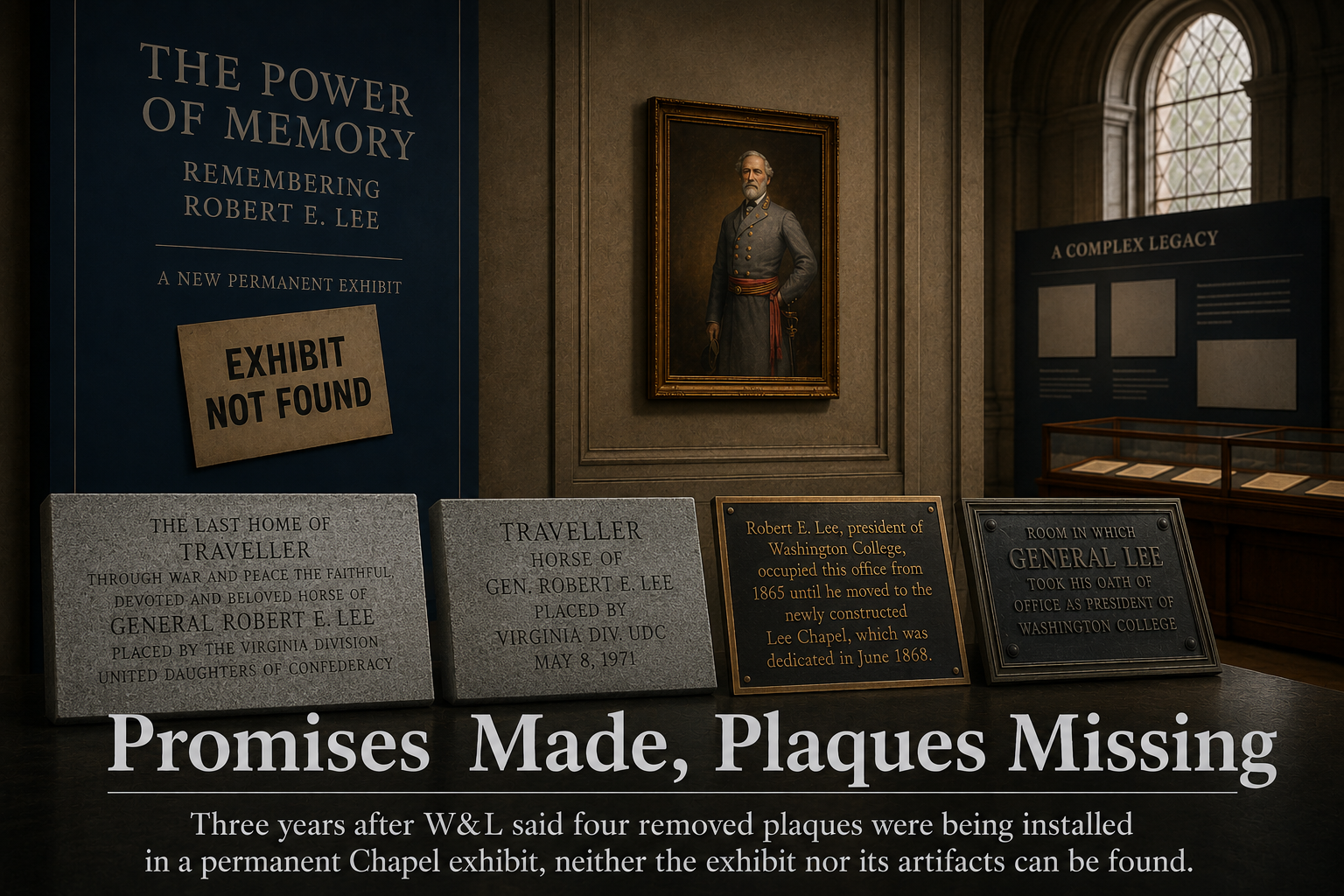
(AI-assisted rendering of the four plaques W&L removed in July 2023 for the promised Power of Memory exhibit. Three years later, none is on display | The Generals Redoubt)
The original headstone of Traveller, Robert E. Lee’s beloved horse, is nowhere to be seen — three years after Washington and Lee officials uprooted it and promised to place it in a new permanent Chapel exhibit.
Also missing are three plaques removed at the same time in July 2023: a marker from the Lee House stables and two brass plaques from Payne Hall marking Lee’s original office and the site of his inauguration as president of Washington College.
Days after the controversial removals, W&L said all four were “being installed” in The Power of Memory: Remembering Robert E. Lee, which they described at the time as a “new permanent exhibit” in the Chapel that was “currently being installed.” The University explained that their relocation was part of a broader effort to “place Confederate artifacts in those exhibits and in context.”
Yet The Power of Memory is nowhere among the newly renovated Chapel galleries that reopened this June. Neither are the four plaques.
“The exhibit titled The Power of Memory: Remembering Robert E. Lee was being planned by the previous executive director of institutional history,” Director of Institutional History Museum and Galleries Matt Davis told TGR in response to questions this week. “The exhibition plans changed with the establishment of the Department of Institutional History Museum and Galleries in July 2024,” he added.
Davis failed to answer several other questions posed by TGR, including where each of the four plaques is today; why The Power of Memory was abandoned; why the plaques were not included in the renovated galleries; whether they will ever return to public display; and whether any are now intended for the proposed Institutional History Museum.
Museums, of course, may change exhibitions and move historic objects. But W&L justified these removals by assuring the community that the plaques would be reinstalled in an educational exhibit and properly contextualized. That plan changed.
Three years later, the plaques remain out of public view. W&L will not say where they will go or when — if ever — the public will see them again.
Unfortunately, this is not the first time W&L has promised a new home for removed plaques and failed to follow through.
The Generals Redoubt has so far identified thirty plaques and memorials removed or relocated during William Dudley’s presidency. Our research traces where these memorials went, what W&L said would happen to them, and whether those plans were ever carried out.
One such plan appeared in 2022, when architectural firm Quinn Evans proposed the controversial partition wall separating the Chapel auditorium from the Recumbent Lee statue. Its design arranged nine of the twenty plaques removed from the sanctuary in 2021 across the wall’s back. By the time the final design was approved in January 2023, the plaque installation had been wiped from the drawings.
“Most of the plaques will be displayed in the chapel galleries or in the new history museum,” then-Director of Institutional History and Museums Lynn Rainville told The Spectator the following month.
She specifically promised that the Liberty Hall Volunteers tablet — which commemorated a famed company of Washington College students and alumni who served together in the Confederate Army — would be displayed in a new exhibit near the Recumbent Lee.
That never occurred.
Davis now says the plaques formerly displayed in the Chapel are represented on a digital display in the auditorium, with some physical plaques included in the new basement galleries and the remainder kept in collection storage.
In five years, W&L has gone from displaying these plaques in the Chapel sanctuary, to promising their physical reinstallation elsewhere in the Chapel, to representing most of them only on a digital display.
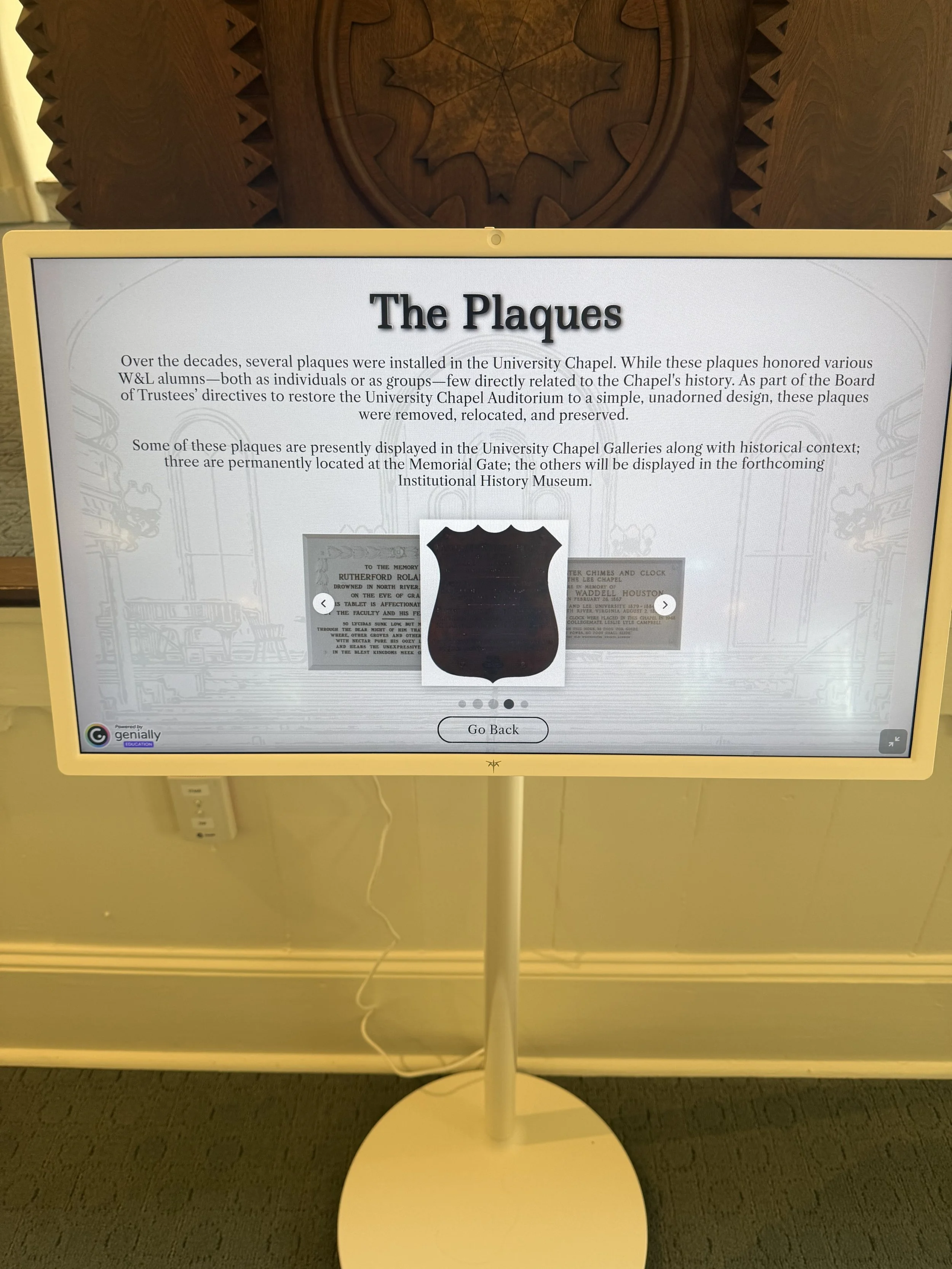
(Photograph of the digital display set up in the chapel sanctuary at Washington and Lee University | The Generals Redoubt)
How many promised destinations must a plaque have before the University simply tells us where it is — and whether it will ever actually be reinstalled?
That question matters as TGR begins a broader review of the new Chapel exhibits. Over the coming months, we will examine their factual accuracy, historical interpretation, design and accessibility, and the policies governing W&L’s historic collections. Museums depend upon selection — what visitors encounter, what receives emphasis and what remains out of view.
W&L supplied its own standard while defending the 2023 removals: one of its objectives, it said, was “presenting the University’s entire history fully and honestly.”
TGR has previously called for greater transparency, outside review, and community engagement from W&L’s museum officials. In “Revision Offered, Review Withheld,” we argued that correcting historical errors only after outsiders discover them is no substitute for transparency throughout the process.
The same principle applies to W&L’s material history. The University should publicly account for the historical objects it removes, explain when plans for their display change, and give the W&L community a meaningful voice in decisions about the material history entrusted to its care.
Until it does, TGR will provide the accounting that W&L has not. We will soon publish our interactive record of the thirty plaques identified to date so the W&L community can see what was removed, what was promised, and what was ultimately restored.
Washington and Lee history should not disappear behind another forgotten promise.
———
This article is the first installment of History on Display, a new series from The Generals Redoubt examining how museums and historic institutions present the past. Through reviews of factual accuracy, historical interpretation, exhibition design, accessibility, curatorial policy, and transparency, the series will consider not only what museums place on display, but what they leave out — and why.